

 It started on an ordinary summer day. The kind of day where the air shimmered with heat and sunlight poured down relentlessly, casting long shadows over the small town of Eldermoor. People went about their routines, enjoying the warmth, savoring the late summer’s simple pleasures. Children played in sprinklers, families gathered for picnics in the park, and couples walked the shaded trails under trees heavy with green leaves.
But by mid-afternoon, a peculiar shift began in the sky. The blue began to deepen, the sunlight dimming just slightly as a blanket of thick clouds crept in from the horizon, casting a shadow over the town. A few people glanced up, curious but unalarmed; an overcast day was rare in summer but not unheard of. By evening, however, a sense of unease had settled over Eldermoor.
The clouds seemed darker than usual, heavier, more like ink than vapor. Streetlights flickered on earlier than normal as shadows stretched across the roads and sidewalks, long fingers of darkness swallowing the familiar shapes of houses and trees. That night, there were no stars, no glimmer of the moon; the sky was pitch black, an impenetrable darkness that seemed to press down on the town like a weighted blanket.
For days, the darkness remained. Eldermoor was trapped beneath the thick veil, which blocked out even the faintest hint of sunlight. Daytime felt like dusk, a strange, dim twilight that left people feeling off-kilter, disoriented. Panic crept through conversations at the grocery store, in hushed voices over coffee cups. Phones buzzed with messages from loved ones, rumors of a strange phenomenon spreading to nearby towns, a strange eclipse that hadn’t been forecasted.
But the strange, unnerving lack of light was only the beginning.
On the fourth night, a teenager named Brian Wilkes reported seeing something while taking out the garbage. It was nearly midnight, the streets silent and empty. He had just set the trash bag by the curb when he heard a soft rustling, like someone—or something—moving in the bushes at the edge of his yard. He turned, peering into the shadows, his heartbeat quickening. The air was thick, the darkness nearly suffocating.
And then he saw it.
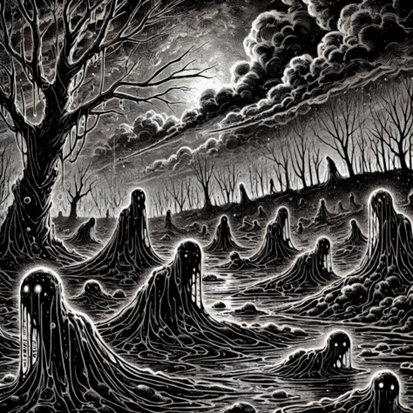
A shape, tall and slender, standing perfectly still just beyond the glow of his porch light. It was unlike anything he had ever seen—a thin, spindly creature with long, sinewy limbs that clung to the ground, almost like a spider. Its skin was slick, black and wet, reflecting the dim light like oil on water. The creature’s body was elongated, its head cocked to one side, as if studying him, though he could see no eyes, only a smooth, featureless face.
Brian’s breath caught in his throat as the creature shifted, lowering itself on all fours, its body tensed, as if ready to pounce. Before he could scream, it turned, moving with unnatural speed, skittering into the darkness on its long, jointed limbs, disappearing into the night.
The next morning, Brian told his parents about the encounter, but they dismissed it as a nightmare, a trick of his imagination brought on by the oppressive darkness. Yet, he couldn’t shake the memory of the creature’s strange, glossy skin, the way it had moved, fluid and silent, as though it were a part of the darkness itself.
Within days, rumors of the creatures spread through town. Eldermoor residents reported glimpses of them lurking in alleyways, slipping between shadows, moving just out of sight. Some claimed they had seen them watching from the woods, their tall, thin forms silhouetted against the darkened trees. Others reported hearing strange, guttural sounds in the night—low, chittering noises that sent chills down their spines.
Then, the disappearances began.
It started with small things: pets left outside at night that never returned, birds that fell silent, leaving the trees and rooftops empty. But soon, people started vanishing too.
The first to disappear was Mr. Grayson, an older man who lived alone on the edge of town. He’d been known for his late-night walks, despite his neighbors warning him of the strange sightings. One evening, he left his house for a stroll and was never seen again. His front door was found wide open, a flashlight lying on the ground, its beam flickering into the endless dark.
Panic spread. People kept to their homes, locking their doors and windows, pulling curtains tight against the strange, all-consuming darkness outside. Families gathered together, huddling in dimly lit rooms, their only company the quiet crackle of emergency broadcasts warning them to stay indoors.
But the creatures grew bolder.
On the sixth night, a family was attacked. The Harpers had been up late, talking in their living room, the uneasy atmosphere making sleep impossible. They heard a soft scratching sound at their back door, faint at first but growing louder, more insistent. Mr. Harper approached cautiously, pressing his ear to the door, his breath shallow.
The scratching stopped.
For a moment, there was only silence. Then, with a force that rattled the entire house, something slammed into the door, shaking it in its frame. The family screamed, pulling back, as the door splintered, the lock giving way, and the thing forced its way inside.
It was one of the creatures, but up close, it was far more terrifying than anyone could have imagined. Its skin glistened, black and wet, dripping onto the floor, a thick, viscous slime pooling at its feet. Its body was thin, almost skeletal, with long, spindly arms and legs that stretched unnaturally, bending at strange angles. Its head was smooth, featureless, its face devoid of eyes or mouth, yet somehow it seemed to sense them, tilting its head as if listening.
The creature let out a low, rattling hiss, dropping to all fours, its body twitching, every movement a strange, jerky shuffle. Then, with a sudden burst of speed, it lunged forward, its limbs moving in a blur, its slick, wet skin leaving a dark trail as it crossed the floor.
The Harpers barely escaped, fleeing out the front door as the creature gave chase, its guttural, inhuman sounds echoing behind them. They ran through the darkness, the creature close on their heels, its slick, clawed hands reaching out, barely missing them as they stumbled down the street, desperate for help.
By dawn, they were gone. No sign of the Harpers remained, only dark smears on their floors, and a silence that settled over the town like a shroud.
As the days passed, Eldermoor was transformed into a place of fear, held captive by an unyielding darkness and a sense of impending doom. The creatures moved freely at night, their strange forms glimpsed in the brief flashes of light from windows or street lamps. People locked themselves in their homes as soon as the dim twilight fell, daring not to venture outside, terrified of the things lurking in the shadows.
By the end of the second week, the darkness had grown thicker, almost physical, pressing against windows and doors like a living thing. The few who remained in Eldermoor were trapped, isolated, surrounded by an endless night and a fear that grew with each passing hour.
In whispers, people spoke of the creatures as if they were shadows brought to life, a darkness given form. They began to call them Night Crawlers, beings born of the strange, oppressive blackness that had swallowed their town whole. No one knew where they came from, or what had brought them, but one thing was clear: they were hunting, claiming the town one soul at a time.
And as the third week began, the townspeople held their breath, wondering who would be next.
Eldermoor had turned into a ghost town. Houses stood dark and silent, their windows covered, doors barricaded. Those who were left moved in whispers, their faces pale, their eyes hollow from sleepless nights. It was as if the town itself had fallen under a spell, frozen in a perpetual twilight where no light could penetrate.
The Night Crawlers, as people had come to call them, grew bolder, their sightings more frequent. Every night, their slick, inky forms would appear on the streets, slipping between the shadows, moving silently along fences, peering into windows. Each sighting brought a fresh wave of terror, leaving people afraid to sleep, afraid to even close their eyes. But staying awake only intensified their despair, the endless darkness pressing in on their minds, making it hard to tell reality from nightmare.
The town organized what little they had left into survival strategies. Some clustered in groups, gathering in homes fortified with furniture and makeshift barricades. They rationed food, took turns keeping watch, their eyes scanning the windows for any sign of movement. Others, however, opted for solitude, convinced that the creatures were drawn to large groups, that their best hope for survival lay in isolation.
One night, as the darkness grew thicker, and the low, guttural sounds of the Night Crawlers echoed in the streets, the town’s emergency radio system crackled to life. Sheriff Dean Blackburn’s voice, rough and steady, filled the airwaves, a lifeline for the frightened people of Eldermoor.
“This is Sheriff Blackburn,” he said, his voice echoing through the static. “I know you’re scared. I know it feels like there’s no way out. But we’re going to get through this. We don’t know what these things are, but we know they don’t like light. If you have flashlights, candles, anything, use them. Keep them close.”
He paused, and there was a hint of desperation in his voice. “We’re working on a plan to drive them out. Some folks have managed to make it to the high school—it’s well-lit and fortified. If you can make it there safely, we’ll be there. We’ll protect each other.”
But his voice trembled as he added, “If you can’t make it, don’t open your doors for anyone after dark. Stay silent. They… they seem to be able to hear us. They’re drawn to sound, to movement.”
The broadcast ended, and Eldermoor fell silent once more. For those still able to move, the high school became a beacon of hope, a place to flee in the rare hours of daylight, though getting there meant crossing blocks of open, unprotected streets.
The next morning, a group of survivors from the neighborhood near the town’s edge decided to attempt the journey to the high school. Among them was Claire Rivers, a mother of two, her face gaunt, her eyes rimmed with exhaustion. She carried her youngest child in her arms, her older son clutching her hand, his face pale with fear.
They moved quickly, sticking to the narrow streets, skirting the darkened alleyways where they’d seen shadows moving the night before. A few others joined them—Mr. Carver, the elderly man who’d refused to leave his home but now wore a look of grim determination; Lisa Moreno, a young woman who hadn’t slept in days, her gaze haunted.
Every creak of wood, every rustling leaf, made them freeze, their breaths held, their hearts pounding. They could feel the creatures nearby, watching from the shadows, as if deciding whether to let them pass or drag them into the darkness.
Halfway to the school, they heard it—a low, chittering sound, followed by the soft thud of claws against pavement. Claire tightened her grip on her children, her heart racing as she saw one of the Night Crawlers slip from the shadows, its oily, black body slinking toward them, its limbs bending at unnatural angles.
“Don’t run,” Mr. Carver whispered, his voice shaking. “They’re faster than us. Stay still. Maybe it’ll leave.”
The creature moved closer, its slick, featureless face pointed directly at them, its body swaying, as if listening. Then, with a sudden, jerking motion, it dropped to all fours, its long limbs spreading wide, crouching, ready to pounce.
In a desperate moment, Claire reached into her bag and pulled out a flashlight, clicking it on and pointing it directly at the creature. The beam cut through the darkness, illuminating the creature’s slimy skin, which glistened in the light like tar. The Night Crawler shrieked, its body writhing as it recoiled from the light, its limbs folding inward as though trying to shield itself.
The group didn’t wait to see if it would recover. They ran, the flashlight casting a shaky beam ahead of them as they bolted through the streets, fear driving them toward the high school. Behind them, they heard the Night Crawler’s enraged hissing, but it didn’t follow, retreating instead into the shadows.
When they finally reached the high school, they found it fortified with floodlights, their beams cutting through the darkness, casting a protective circle around the building. Sheriff Blackburn and a handful of volunteers had set up barriers at the entrances, armed with flashlights and other makeshift defenses. Inside, families huddled together, their faces pale, their eyes hollow with fear and exhaustion.
Claire and her children were quickly ushered inside, joining the other survivors in the dimly lit gymnasium where rows of cots had been set up. The room was tense, every creak of the building setting nerves on edge, every shadow a potential threat. But in the safety of the light, they found a fragile sense of hope.
The sheriff spoke quietly to the group, his voice steady but grim. “We’re doing what we can. We’re safe as long as the lights stay on, but we can’t stay here forever. The generators are running low, and the longer this darkness holds, the more dangerous it’ll get. We need to find a way to get supplies—and maybe a way out.”
A heavy silence settled over the group as they realized the dire reality of their situation. The darkness was spreading, consuming everything in its path, and they were running out of time.
That night, as the survivors huddled in the dim light, Sheriff Blackburn and a few volunteers ventured out to find fuel and food. They kept to the main roads, staying close to the light, their flashlights cutting narrow beams through the blackness. The town was silent, deserted, but as they moved deeper into the residential area, they came upon a grisly scene.
Dozens of people, taken in the night, their bodies half-hidden in the darkness, their faces twisted in expressions of terror. The sheriff’s flashlight revealed long, clawed marks on the walls, dark stains on the ground, signs of struggle and despair. The Night Crawlers had claimed the town, leaving only the high school as the final sanctuary.
Sheriff Blackburn’s face hardened, and he turned to his group, his voice low and filled with resolve. “We’re outnumbered, and we’re running out of options. If we stay, we die. Tomorrow, we move. We head for the next town and hope to find help. No matter what we hear, no matter what we see, we don’t stop until we’re clear of this place.”
They returned to the high school, their grim expressions alerting the others to the horror that awaited them outside. But there was no time for despair—only the fight for survival.
At dawn, as the dim light of another sunless day struggled to break through the darkness, the survivors prepared to leave. Armed with flashlights, makeshift weapons, and sheer determination, they formed a tight group, ready to make the journey to the next town. Sheriff Blackburn led the way, his face set with grim purpose, his eyes scanning the shadows for any sign of movement.
The journey was brutal. The Night Crawlers were everywhere, slipping between shadows, their inky forms skittering along the ground, lunging at anyone who strayed too close. But the survivors held their ground, their flashlights keeping the creatures at bay, pushing through the darkness with nothing but each other and the light they carried.
By the time they reached the edge of town, many were injured, their numbers fewer than when they had started. But they were alive, and as they left Eldermoor behind, they felt the weight of the darkness lifting, the sky growing lighter, the oppressive silence giving way to the sounds of the world beyond.
As they looked back, they could see the Night Crawlers standing at the town’s edge, watching them with hollow faces, waiting, as though bound to the darkness that had consumed Eldermoor. And the survivors knew that as long as the darkness remained, the Night Crawlers would continue to haunt the empty streets, claiming any soul that dared to return.
They left with heavy hearts, knowing that Eldermoor was lost, swallowed by a darkness that would never release it.
Days after the survivors’ escape from Eldermoor, the nearby town of Ashgrove had become a place of refuge and rumor. Word of the strange darkness that had consumed Eldermoor spread quickly, capturing the attention of locals and outsiders alike. Some called it a hoax, a wild story born of panic, while others whispered of ancient curses and otherworldly forces.
But for Sheriff Blackburn and the others who had witnessed the horrors firsthand, the darkness and its creatures were terrifyingly real. Determined to find answers, Blackburn reached out to a professor of ancient cultures and mythology, Dr. Evelyn Harper, hoping she could help unravel the mystery of the darkness and the creatures haunting Eldermoor.
Dr. Harper was a distinguished researcher specializing in obscure legends and ancient rituals. She listened intently as Blackburn recounted the events that had unfolded in Eldermoor, her face growing more serious with each word. After a long silence, she produced an old, leather-bound journal, its pages yellowed with age, covered in handwritten notes and sketches.
“This journal belonged to my grandfather,” she explained, her voice low. “He was an archaeologist who studied lost civilizations and ancient curses. Decades ago, he led an expedition into an isolated area of the Amazon rainforest, where he encountered a tribe that had legends of a ‘Dark Veil’—a phenomenon where night fell without end, bringing with it creatures that hunted in the shadows.”
Blackburn leaned in, his pulse quickening. “You think that darkness in Eldermoor is related?”
Dr. Harper nodded. “There are disturbing similarities. According to the tribe’s legend, the Dark Veil was a punishment—a curse meant to trap wandering souls in a never-ending night, a boundary between the living and the dead. The creatures, which they called Kar’karun, were once human, souls who had become bound to the darkness, twisted into hunting shadows, doomed to prey upon anything living within the Veil.”
As Blackburn scanned the journal, he saw sketches of thin, elongated figures—creatures with slick, featureless faces, just like the Night Crawlers. Scribbled notes described their inky black skin, their animalistic movement, and a warning: Beware the Whispering Dark; it devours all light.
Digging deeper into the journal, they found accounts of a ritual used by the tribe to protect themselves from the Dark Veil. The ritual, performed only by the most revered shamans, was said to ward off the darkness by creating a barrier of light. According to the notes, the ritual was difficult and dangerous, as it required gathering several specific elements from sacred places.
The final page held a faded drawing of a stone altar, surrounded by symbols and torches. Beneath it, a scrawled note read, To release the Veil is to release the curse. To awaken the forgotten is to become their prey.
Dr. Harper looked up, her face grave. “The tribe believed the Veil could be summoned by accident, that disturbing certain places or rituals could unleash the darkness and awaken the Kar’karun. It’s possible that someone, or something, triggered the Veil over Eldermoor.”
Blackburn’s mind raced. “So if someone disrupted this… ancient boundary, they could have unintentionally released the darkness?”
Dr. Harper nodded. “It’s possible. And once the Veil is opened, it consumes everything within its reach, trapping anything it touches in a realm between worlds. The creatures—the Night Crawlers—are the guardians of that darkness. They hunt to maintain the Veil, to keep the living from escaping its grasp.”
Determined to find the source of the darkness and put an end to it, Blackburn and Dr. Harper made plans to return to Eldermoor. They gathered a small team, equipped with powerful lights and a portable generator, hoping the intense light would hold the creatures at bay long enough for them to investigate the town and search for the disrupted boundary.
As they approached the town, the darkness grew thicker, almost physical, as if pressing against them, resisting their intrusion. The town was silent, every building deserted, the streets empty. Their flashlights cut narrow beams through the blackness, illuminating glimpses of claw marks on walls, windows shattered from the inside, remnants of lives interrupted by terror.
They followed Dr. Harper’s map to a small clearing just outside the town, where an old stone structure lay half-buried in the earth. It was overgrown with weeds, obscured by time and shadow, yet unmistakably similar to the altar depicted in her grandfather’s journal.
“This is it,” Dr. Harper whispered, her voice tense. “The boundary marker.”
As they began to examine the stones, they found markings scratched into the earth around the altar, symbols that appeared recent, as though someone had disturbed the ground. There were candle stubs, remnants of ash, and small bones scattered around—a hastily performed ritual, one that had likely gone horribly wrong.
“It must have been a local or someone who knew of the legend,” Blackburn said, his voice filled with dread. “Someone tried to summon something without understanding what they were releasing.”
Dr. Harper nodded grimly. “They opened the Veil, inviting the darkness in. Now it’s here, and the Kar’karun are bound to it, hunting until there’s nothing left to consume.”
Realizing that they had one chance to close the Veil, Dr. Harper and Blackburn prepared to perform the ancient ritual. They set up a ring of powerful floodlights around the altar, hoping to recreate the barrier of light described in the journal. With a shaky hand, Dr. Harper lit torches and placed them at each corner of the altar, chanting in the old language transcribed in her grandfather’s notes.
As the light intensified, the darkness seemed to retreat, pulling back from the town’s edge. But as Dr. Harper continued, the air grew colder, and the low, guttural sounds of the Kar’karun filled the clearing. Figures began to emerge from the shadows—dozens of Night Crawlers, their slick black bodies skittering toward the edge of the light, their faces featureless, blank, yet somehow filled with a terrible hunger.
The creatures moved closer, testing the boundary of light, their limbs stretching, claws reaching for any weakness in the circle. Dr. Harper’s voice wavered, but she continued, her chants rising in intensity as the light pulsed, pushing the creatures back, their shrieks echoing in the night.
The Veil seemed to waver, the darkness pulsing, flickering, as though trying to cling to the town, to the world. And then, with one final, desperate burst of light, the barrier held, and the darkness shattered.
The Kar’karun shrieked, their bodies dissolving into the shadows, their forms disintegrating as the darkness lifted, releasing Eldermoor from its grip. The sky brightened, the oppressive weight lifted, and the town was bathed in the soft, golden light of dawn for the first time in weeks.
As the first rays of sunlight touched the town, Blackburn and Dr. Harper stood in silence, their faces pale, their minds numb with the memory of what they had witnessed. Eldermoor lay in ruins, its streets empty, its buildings scarred by the darkness. But the town was free, the Veil lifted, the Kar’karun gone—at least for now.
Dr. Harper looked to Blackburn, her expression somber. “The Veil is fragile. It could be reopened, even by accident. The darkness will always be there, waiting.”
Blackburn nodded, understanding the gravity of her words. “We’ll warn others. Make sure no one disturbs this place again.”
Together, they left Eldermoor behind, knowing they had encountered forces beyond comprehension, an ancient darkness that lingered in the hidden places of the world, waiting for the unwary, the curious, to open the door once more.
And as they drove away, they couldn’t shake the feeling that, somewhere in the shadows, the Kar’karun were still watching, waiting patiently for the night to return.
The survivors of Eldermoor settled uneasily in Ashgrove, struggling to rebuild their lives in the aftermath of the darkness. The memories of the Night Crawlers haunted them, the terror they had experienced etched into their minds like scars. Each night, the darkness felt heavier, the shadows deeper, as though remnants of the Veil lingered around them, watching from the edges of the light.
Claire Rivers, who had fled Eldermoor with her children, tried to create a sense of normalcy, enrolling them in a new school, filling their days with routines. But each night, she found herself double-checking the locks, positioning flashlights by the door, her nerves on edge. Her children were plagued by nightmares, visions of slick, black shapes moving through their rooms, silent whispers calling them into the night.
Dr. Evelyn Harper and Sheriff Dean Blackburn continued their research, combing through the journals and any records they could find, hoping to uncover more about the Veil and its dark guardians. They knew the Kar’karun were bound to the darkness, part of an ancient curse that could resurface if the Veil was disturbed again. The Veil was fragile, a boundary between worlds that required only a single mistake to unleash chaos.
Months later, a peculiar package arrived at the Ashgrove Historical Society, addressed to Dr. Harper. Inside was a small, polished stone covered in strange, ancient symbols, a relic she hadn’t seen in any of her studies. With it was a note scrawled in shaky handwriting:
The darkness waits for those who seek it. Beware the whispers; they know the way back.
Dr. Harper’s hand trembled as she read the note, her mind racing. She didn’t know who had sent it, but the message was clear—the Veil was far from gone, and the Kar’karun were only a shadow away.
Blackburn and Dr. Harper shared a grim understanding: while Eldermoor might have been freed, the darkness was never truly vanquished. It was part of something older, waiting in the spaces between worlds, drawn to those who dared to search too deeply, to those who ignored the warnings etched into the bones of forgotten places.
They kept the relic locked in a glass case, a warning to anyone who visited the Historical Society. But every so often, Evelyn would catch a glimpse of something in its reflection, a shadowed figure standing behind her, watching, waiting. She felt the same cold, silent dread each time—a reminder that the Kar’karun were patient, timeless.
And as long as the Veil endured, so too would the darkness, lurking in the corners of the world, waiting to consume the next soul who dared to open the door to the other side.
The End
