

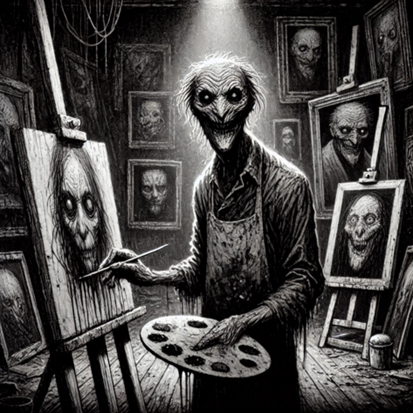
 The studio was shrouded in quiet shadows, its only light coming from a single lamp casting a warm, steady glow across a nearly finished canvas. Julian Mercer leaned in close, his fingers dancing over the oil paint, adding the final, delicate strokes to the image before him. The woman’s face on the canvas looked back at him, her eyes haunting, a mixture of beauty and pain. Julian felt a thrill as he painted, the brush gliding with precision, his movements precise, intimate, as though he were capturing more than just her likeness.
Julian was fresh from the Rhode Island School of Design, a recent graduate whose talent had caught the eye of New York’s most discerning art critics. His work was different—hypnotic, unsettling, his portraits possessed a depth that seemed to pull the viewer in, to touch something beyond the skin, something uncomfortably close to the soul. Within weeks of arriving in New York, he had been picked up by one of the city’s most prestigious galleries, Kessler & Associates, with a promise of exhibitions, representation, and a growing list of clients who couldn’t wait to own a piece of his work.
But there was a darkness in Julian’s process, a secret that lay beneath the surface of his canvases. What the gallery owners, his patrons, and even his closest friends didn’t know was that Julian didn’t just paint his models—he consumed them, quite literally. Each of his portraits was a macabre masterpiece, created not just with paint, but with pieces of the women themselves—strands of hair, droplets of blood, fragments of bone—woven into the layers of oil paint, bound into the very essence of his work.
This was his signature, the final step in his process: to immortalize his subjects by making them part of the canvas, an offering that captured not just their beauty, but their very being.
Julian’s career had exploded almost overnight. His first exhibition had been a sold-out success, and his clients were clamoring for more, drawn to the dark allure of his work. They couldn’t explain it, but there was something visceral about his portraits, something that seemed to reach out from the canvas, whispering secrets, holding their gaze with an intensity that was almost hypnotic.
As he walked into the Kessler Gallery that afternoon, he could see the heads turning, the hushed whispers of admiration from patrons and staff alike. Julian was greeted by Miriam Kessler herself, the gallery’s owner, a shrewd woman who had built an empire around spotting raw, unsettling talent.
“Julian,” she said, her voice warm, her eyes glinting with excitement. “You’re becoming quite the sensation. We already have clients eager to commission their own portraits. Tell me, are you ready to take on a few?”
Julian forced a smile, though the words were music to his ears. “Of course, Miriam. I’m always ready to create.”
She led him into her office, where a small group of patrons awaited him—wealthy art collectors, high-profile socialites, each eager to introduce themselves, to be in the presence of the gallery’s newest star. As he shook hands and exchanged pleasantries, Julian couldn’t help but feel a thrill at the prospect. His next muse was likely standing right in front of him.
After the meeting, Miriam handed him a list of names, each one accompanied by a promise of payment far beyond what he’d been making as a student. Julian scanned the list, his eyes lingering on one name in particular: Lila Montgomery.
Lila was a well-known figure in the art world, a woman of impeccable taste and a beauty that had enchanted artists and photographers for years. She was also one of the gallery’s wealthiest clients, and she’d requested a portrait done by Julian herself. The thought of capturing her, of making her part of his next work, sent a dark excitement coursing through him.
Days later, Lila arrived at Julian’s studio, her presence filling the room with an almost ethereal beauty. She was elegant, poised, with striking eyes that seemed to see right through him. Julian studied her as she took her place on the small platform he’d set up, her movements graceful, her features illuminated by the soft glow of his studio lights.
He began with the basics, sketching her outline, filling in the delicate details of her face, her eyes, her lips. As he worked, they spoke, Lila asking questions about his inspirations, his process, and the things that drove him to create. Julian was careful with his answers, steering the conversation away from anything that might give her pause. He painted her with focus, his mind already thinking of the final step, the ritual that would complete the portrait and make it uniquely his.
By the time he finished the first session, he had captured Lila’s likeness, the beginnings of her portrait emerging from the canvas like a haunting reflection of her beauty. But it wasn’t enough. For Julian, a painting wasn’t complete until he had imbued it with the essence of his subject, a practice he had perfected over the years, first with small animals, then with anonymous models he’d hired during his time in school.
But Lila was different. She was famous, wealthy, and people would notice if she simply vanished. He needed to be cautious, to draw her in slowly, ensuring she trusted him, that she would return for session after session, until he had enough of her essence to complete the work.
Julian waited until the third session to initiate the next step. As Lila sat on the platform, holding a glass of water he’d prepared for her, Julian noticed the faintest twinge of drowsiness in her eyes. She blinked, fighting off the effects of the sedative he’d slipped into her drink, her eyelids growing heavy as she began to drift into a light sleep.
Once she was unconscious, Julian moved quickly. He took a sterilized scalpel from his toolkit, carefully snipping a few strands of her hair, wrapping them around his fingers before mixing them with the oils on his palette. He added the hair to the canvas, blending it into the background, each stroke filled with a dark satisfaction.
The process had begun. Each time she returned, he would take a little more—a few drops of blood drawn under the guise of a finger prick for color mixing, a nail clipping tucked discreetly into the shadows of the painting. Over time, the canvas began to change, Lila’s face becoming more lifelike, her eyes glinting with a light that seemed almost real. Julian could feel the thrill of creation, the sense of power that came with knowing he was binding her essence to the work, making her part of it forever.
Weeks passed, and the gallery hung Lila’s portrait in the main showroom, an unveiling that drew attention from critics and collectors alike. The painting was exquisite, haunting, Lila’s eyes staring out from the canvas with an intensity that left viewers mesmerized. It sold within hours of its unveiling, purchased by an anonymous buyer with instructions for immediate delivery.
But then the questions started.
“Who was the model?” one patron asked him at a gallery event, his eyes lingering on the fine details of another portrait, this one of a young woman with dark hair and a soft smile.
Julian offered a vague smile, brushing off the question. “An acquaintance. She agreed to model for me but preferred to remain anonymous.”
But the questions continued. One of the gallery’s patrons recognized the woman in his previous portrait as a model who had vanished several months earlier, her disappearance unsolved, the investigation turning cold. Another client, studying one of Julian’s smaller works, claimed to know the young woman on the canvas, a server at a bar downtown who hadn’t been seen in weeks.
Rumors began to circulate—whispers that his models had vanished, that they had somehow become part of the paintings themselves. Clients asked the gallery staff, hinting at the eerie lifelikeness of the portraits, the sense that each subject was somehow frozen in time, staring out from the canvas with eyes that seemed almost real.
As Julian worked on his latest portrait, he could feel the net closing in, the questions growing louder, the whispers following him wherever he went. But he couldn’t stop—not when he was so close. His obsession had taken hold, driving him to finish the final portrait, a piece that he knew would capture Lila’s beauty in a way that no other work had before.
On the night of the last session, he lured her into the studio, offering her wine, soft music, his charm as he prepared her for the final sitting. This time, he would take more than just a few strands of hair or drops of blood. He would take enough to bind her fully to the canvas, to make her essence part of the painting itself.
But as he moved toward her, scalpel in hand, he felt a shift in the air—a presence, a pressure that seemed to emanate from the walls themselves. The portraits hanging in the studio seemed to watch him, their eyes fixed on him, accusing, silent, as though the women within them were somehow aware of his actions, their spirits trapped, bound to the canvases, bearing witness to the darkness he had woven into his art.
For the first time, Julian felt a chill of fear, a whisper of something dark and powerful, as though the souls of his models were reaching out to him, calling for justice.
And as he lifted the scalpel, his hands trembling, he felt it—a presence behind him, cold fingers pressing into his shoulder, a low, whispering voice in his ear, filled with fury and pain.
“Let us go…”
The studio fell silent, the shadows deepening, and Julian realized, with a bone-deep terror, that his art had claimed him too.
The studio was silent, thick with an atmosphere that seemed to pulse with something dark and unseen. Julian stood alone, surrounded by his own creations, the eyes of his painted muses watching him from every corner. The air was colder than usual, a chill that had nothing to do with the season, but he tried to ignore it, forcing himself to focus on his work.
He thought he could silence the doubts, push away the feeling that something was wrong. But every time he looked at his canvases, the faces of his models seemed to change, their expressions twisting, their eyes staring at him with a mixture of sorrow and anger. It was subtle, barely perceptible, but he could feel it—the sense that they were watching, waiting, and that they knew what he had done.
Julian wiped his hands, his eyes moving over the canvases that lined the walls. Lila’s portrait hung in the center, her eyes glinting with a depth that went beyond mere paint. There was something alive in her gaze, a flicker of accusation that he could feel whenever he met her eyes.
He shook his head, muttering to himself, willing away the unease that had settled over him. But as he turned away from the painting, he heard it—a faint, almost imperceptible whisper, barely more than a breath.
“Why did you take us?”
Julian froze, his pulse quickening. He looked around the studio, but he was alone. He could feel a cold sweat trickling down his spine, the whisper echoing in his mind, filling him with a dread that he couldn’t ignore. He forced himself to breathe, to calm down, but the whisper returned, louder this time, filled with a sorrow that seemed to seep into the walls.
“Let us go…”
He stepped back, his gaze darting to the paintings, his mind racing. He tried to convince himself that it was his imagination, a trick of the mind. But the feeling only grew stronger, an oppressive weight that pressed down on him, filling the studio with an energy that felt almost alive.
Days passed, but Julian’s sense of unease only deepened. He barely left his studio, driven by an obsession to finish his latest piece—a self-portrait, one that would capture his own genius, his intensity, the raw talent that had propelled him to fame. But every time he tried to paint, he felt a resistance, a heaviness that made it impossible to focus. The brush would shake in his hand, the paint would smear, and his reflection in the mirror would seem to change, taking on a hollow, haunted look.
He became increasingly paranoid, convinced that he could hear whispers in the dead of night, faint voices calling his name, accusing, pleading. The voices grew louder, filling the silence, until they became impossible to ignore. He saw shadows moving in the corners of his studio, figures flickering just beyond his vision, and he could feel their eyes on him, watching, waiting.
One night, as he sat alone in his studio, he caught sight of something that made his blood run cold. In Lila’s portrait, her face seemed to have changed—the delicate lines of her features twisted, her eyes filled with a rage he hadn’t painted, her mouth open as though frozen mid-scream. It was subtle, barely noticeable, but he could feel it, a shift in the energy of the room, a presence that was as real as his own.
He stumbled back, his heart pounding, the faces in his paintings seeming to loom over him, their expressions shifting, each one filled with a silent fury. He could feel their eyes on him, and in that moment, he knew—he had bound their spirits to the canvases, but they weren’t as silent as he had thought. They were there, trapped, aware, and they wanted vengeance.
That night, Julian barely slept. He lay awake, staring at the ceiling, his mind racing with the knowledge that his muses were watching him, that their spirits lingered, bound to the canvases, waiting for their moment. He tried to convince himself it was all in his head, the result of too many late nights and too much time alone. But the feeling persisted, a gnawing dread that settled into his bones, filling him with a fear he couldn’t shake.
As dawn approached, he slipped into a restless sleep, his mind drifting in and out of nightmares. He dreamed of his studio, but it was dark, silent, filled with shadows. The faces in his paintings stared at him, their eyes hollow, accusing, their mouths twisted in silent screams.
And then he saw her—Lila, standing at the edge of the room, her body thin, almost skeletal, her face a mask of sorrow and fury. She reached out to him, her fingers long, bony, her eyes fixed on him with a gaze that pierced his soul.
“Let us go,” she whispered, her voice soft, filled with an anguish that chilled him to the core. “Why did you take us? Why did you bind us here?”
Julian tried to speak, to explain, but his words caught in his throat, his voice a strangled gasp. He could feel her presence pressing down on him, her spirit heavy, oppressive, filling the room with an energy that seemed to sap the very air from his lungs.
And then she lunged at him, her hands reaching for his throat, her fingers cold as ice, closing around his neck, her voice a scream that echoed through his mind.
“Release us!”
Julian woke with a start, gasping for breath, his body drenched in sweat. The studio was silent, but he could feel her presence lingering, a weight that pressed down on him, filling him with a fear that he couldn’t shake. He knew, in that moment, that he was no longer alone.
Over the next few days, Julian became consumed by his guilt, haunted by the faces of his victims, the knowledge that he had taken their lives, bound them to his art, trapping their souls within his canvases. He could feel their presence, the energy in his studio growing darker, heavier, as though the walls themselves were closing in on him.
He stopped painting, abandoning his brushes, his palette, his self-portrait half-finished, the colors dull and lifeless. The whispers had grown louder, filling his mind with a constant, unrelenting chorus of voices, each one calling his name, accusing, pleading.
Driven to the edge of madness, he searched for a way to free them, desperate to release the souls he had bound, to silence the voices that haunted him. He poured over old texts, books on the occult, rituals that promised to release spirits, to sever the ties that bound them to the physical world. But no matter what he tried, the spirits remained, their presence growing stronger, their whispers filling his mind with a darkness that seemed to seep into his very soul.
One night, as he stood before Lila’s portrait, his mind fractured, his body weak, he raised a knife, his hand trembling as he prepared to cut through the canvas, hoping that it might release her, free her from the prison he had created.
But as the blade touched the surface, a cold wind swept through the studio, extinguishing the lights, plunging him into darkness. The shadows closed in, thick and suffocating, and he could feel them, the spirits of his muses, pressing against him, their hands reaching for him, their voices a low, haunting whisper.
“You cannot free us, Julian,” they said, their voices blending into a single, chilling harmony. “You bound us here, and now… you will join us.”
He tried to scream, to run, but their hands closed around him, pulling him into the darkness, their fingers cold and unyielding. He felt his body growing heavy, his vision blurring, his soul slipping away, bound to the very canvases that had claimed his victims.
And as the darkness consumed him, he saw his reflection in Lila’s eyes, his face twisted in terror, frozen forever within the canvas, a final masterpiece, a haunting reminder of the price of his obsession.
It was nearly a month after Julian Mercer’s sudden disappearance that Miriam Kessler, the owner of Kessler Gallery, began to grow concerned. His clients, growing impatient, had demanded answers about their unfinished commissions, but Julian hadn’t returned any calls, emails, or messages. She tried reaching out to his friends and family, but no one had seen him. His reputation was too valuable to let go, so she decided to investigate herself.
On a cold, gray afternoon, Miriam arrived at Julian’s studio, a narrow, dimly lit space in the East Village. The building manager unlocked the door, pushing it open with a shrug before quickly excusing himself, leaving Miriam to step inside alone.
The air was stale, thick with the scent of oil paint and something darker, metallic, that lingered beneath it. Shadows pooled in the corners of the room, as though the light itself dared not intrude. Miriam shivered as she looked around, her eyes adjusting to the dim light, taking in the canvases that lined the walls. They were Julian’s works, each one an exquisite portrait, a masterpiece, but as she stepped closer, something about them unsettled her.
The first canvas she approached was of a woman she recognized—a young model who had gone missing several months earlier. The woman’s eyes seemed to follow her, their gaze intense, almost pleading, and Miriam felt a chill crawl down her spine as she reached out, her fingers grazing the surface. The paint felt strange, rough, as though something were woven into it, something that made her pull her hand back instinctively.
Moving further into the studio, Miriam stopped in front of Lila Montgomery’s portrait. She’d heard rumors of Lila’s disappearance, the whispered suspicions that surrounded Julian, but she had never believed them. Now, standing face to face with Lila’s image, she couldn’t ignore the feeling of dread that seeped into her, chilling her to the core.
Lila’s eyes were different from the others, filled with a rage that seemed barely contained, as though she were trying to reach out, to break free from the canvas. Her mouth, painted with haunting precision, seemed frozen mid-scream, her expression one of desperation and fury.
Miriam took a step back, her mind racing, the horrifying realization dawning on her. She remembered the whispers, the unsettling rumors about Julian’s process, the clients who had asked where his models had gone, and now, looking at these portraits, she understood the truth.
The models weren’t missing—they were here, their spirits bound to the canvases, trapped within the layers of paint, woven into the fibers of the canvas, victims of Julian’s twisted artistry.
Her eyes moved to Julian’s final work, a half-finished self-portrait propped on an easel near the center of the room. She approached it slowly, her breath catching as she took in the details. Julian’s face stared back at her, but it wasn’t the confident, smirking expression she remembered. His eyes were hollow, wide with terror, his mouth twisted in a silent scream, his hand reaching out, as though he were trying to escape.
The painting had an unnatural depth, an almost lifelike quality that made her skin crawl. She took a step closer, squinting, and for a fleeting moment, she thought she saw his hand move, his fingers pressing against the canvas, his face twisting in agony.
A faint, almost imperceptible whisper echoed in the room, a single word that sent a chill down her spine.
“Help…”
Miriam stumbled back, her heart racing, the portraits seeming to close in around her, their eyes filled with anger, pain, desperation. She could feel them watching, could hear the faintest murmur of voices, their whispers blending into a low, haunting chorus, filling the air with a sense of longing, a plea for freedom.
Unable to bear it any longer, Miriam turned and fled, slamming the door behind her. She could still feel their eyes on her as she hurried down the hall, their silent screams echoing in her mind, haunting her with the knowledge that their souls remained trapped, bound to the canvases, held captive by Julian’s dark legacy.
The gallery would remain empty, Julian’s work untouched, his final collection hidden from the world, a testament to his twisted genius, a prison for the souls he had taken.
And in the quiet, shadowed corners of the abandoned studio, the portraits waited, their eyes watching, their whispers growing louder, their rage building, waiting for the moment when someone else would dare to step inside, to gaze upon the haunted faces, and hear their desperate plea:
Release us.
Months passed, and rumors about Julian Mercer’s disappearance continued to circulate through New York’s art scene, his absence leaving a lingering mystery. His studio remained sealed, abandoned, the whispers about his final works growing darker, the chilling reality of his creations an unspoken truth among those who had known him. But not everyone was content to leave the mystery unsolved.
A few weeks after Miriam’s fateful visit to the studio, an art restoration specialist named Dr. Harold Thompson was approached by a collector who had privately purchased one of Julian’s early works. The painting—a haunting portrait of a young woman with deep, piercing eyes—had a strange quality that was wearing at the collector, a feeling that something dark and unseen was embedded within it. The client insisted that Harold examine the piece, to uncover whatever secrets might lie beneath its surface.
Curious, Harold took on the project, unaware of what lay in store. He set up the painting in his lab, scrutinizing it with a restorer’s trained eye. The portrait was beautiful, disturbingly so, but as he moved closer, he noticed something strange about the texture. There were inconsistencies in the layers, odd fibers embedded within the paint, giving it an almost organic feel.
Setting up a microscope, Harold took a small sample from a discreet area of the canvas, a fragment of the dark paint that made up the background. He placed it under the lens, adjusting the magnification, and his heart skipped a beat when he saw it—hair. Human hair, embedded into the layers of paint, woven into the very fabric of the piece. Shocked, he moved to another area of the painting, scraping a small fleck from the edge, and found more—this time, a sliver of what looked like fingernail.
A sense of horror washed over him as he realized the implications. Julian’s paintings weren’t just art—they were physical pieces of his models, their essence bound to the canvas in a literal, macabre form.
Unable to contain his curiosity, Harold conducted further analysis, taking samples from various parts of the painting. What he uncovered was more unsettling than he could have imagined: bloodstains, traces of bone, and other organic materials, all blended seamlessly into the oil, each stroke a fusion of pigment and human remains. It was as if Julian had painted not just his subjects’ images, but their very beings.
Driven by a morbid fascination, Harold reached out to other collectors known to own Julian’s work, securing permission to examine additional pieces. One by one, he confirmed his suspicion. Each painting contained organic material—hair, blood, even minuscule fragments of bone. The paintings were not just likenesses; they were vessels, each one containing a part of the model’s very essence, bound forever within the strokes of Julian’s brush.
As Harold examined the paintings, he began to feel an almost tangible presence emanating from them. Alone in his lab, he would hear faint whispers, soft murmurs that seemed to come from the shadows, voices echoing in the silent room. The portraits themselves seemed to shift, their expressions twisting in subtle, unsettling ways, as though aware of his intrusion, resentful of the scrutiny.
But the more he uncovered, the deeper his horror grew. Julian hadn’t just painted these women—he had trapped their souls, binding their life force to the canvases. Each painting wasn’t merely an image; it was a prison, a cursed artifact housing the trapped spirit of a once-living person.
Haunted by his discoveries, Harold dove into the murky depths of Julian’s life, searching for any clues that might explain how such a horrific practice had begun. He scoured old interviews, personal letters, and any record he could find of Julian’s time at the Rhode Island School of Design. Finally, buried in the university’s archives, he came across a thesis Julian had written during his final year. The document was titled “The Bound Form: Capturing Essence Through Art”—a strange, academic-sounding title, but one that hinted at a disturbing obsession.
The thesis was a mixture of art theory, psychological musings, and occult references. Julian wrote about the “power of art to transcend the physical,” the idea that a portrait could capture more than just a likeness; it could capture a person’s very soul. He cited historical accounts of ancient civilizations, tribes that believed portraits could imprison spirits, keeping them bound to a specific place or object. There were references to dark rituals, alchemical processes, and spells used by early artists to imbue their work with a form of life.
But the most disturbing part was Julian’s description of his own experiments, practices he had undertaken in secret. He described his process in chilling detail—how he would mix his subjects’ hair, blood, and fragments of bone into his paint, a “final binding” that would capture their essence, making the painting more than just an image, but a “living vessel.” He wrote about the thrill he felt, the satisfaction of knowing that his subjects would live forever through his art, each one becoming an eternal part of his legacy.
The thesis ended abruptly, as though Julian had cut himself off, aware that his theories might be seen as nothing short of monstrous. Harold felt a sickening realization wash over him: Julian hadn’t seen his actions as murder, but as a form of immortality, a way of elevating his art to something divine. The models he had killed weren’t victims to him—they were offerings, sacrifices to his own twisted vision of art.
Harold knew he had stumbled upon something far darker than he could have imagined, and the more he uncovered, the more the whispers grew, filling his mind, invading his dreams. The paintings haunted him, the faces of Julian’s victims seeming to watch him wherever he went, their eyes filled with silent pleas. He felt their presence, a tangible weight that lingered in the air, and he realized with a bone-deep dread that their spirits weren’t at rest. They were trapped, bound to the canvases, screaming for release.
Determined to put an end to Julian’s legacy, Harold began a process he had never attempted before. Working carefully, he stripped the paintings, meticulously scraping away the layers, hoping to separate the organic material from the paint, to sever the connection that bound the spirits within. But each attempt was met with resistance—the air around him growing colder, the whispers louder, the lights flickering as though the spirits were fighting against his efforts.
Then, one night, as he worked on the final portrait—a half-finished image of Julian himself—the painting began to change. The eyes in the portrait seemed to narrow, the face twisting into a look of pure malice. Harold felt a cold hand press against his back, heard a voice whisper in his ear, low and filled with rage.
“You think you can undo what I’ve created?” the voice hissed, unmistakably Julian’s. “They are mine. Forever.”
The room grew dark, the shadows thickening around him, pressing down on him, filling his lungs with a cold that felt like death. The faces of the models appeared around him, their eyes filled with sorrow, with fear, reaching out, desperate, pleading. And as the darkness closed in, Harold understood, with a sickening certainty, that the souls were beyond saving, bound to Julian’s cursed art by a power far darker than he could break.
The next morning, Harold’s assistant found the lab in disarray, the paintings scattered, the canvases torn, but Harold was nowhere to be found. The portraits remained untouched, their eyes filled with the same haunting expressions, as though aware of the attempts to destroy them, bound now by not only Julian’s sinister art but the souls of those who had dared to reveal his secrets.
And in the shadows, in the quiet halls of the Kessler Gallery where the paintings would eventually return, the whispers grew louder, waiting for the next unlucky soul to look into the haunted eyes, to feel the weight of the souls trapped within, to hear the silent, endless chorus of voices calling out in desperation:
“Help us…”
The End
