

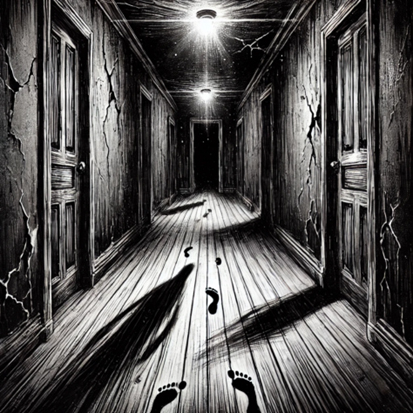
 The clock read 2:47 a.m., and the only sounds in the house were the soft breaths of Peter and Emily, lost in sleep, and the occasional hum of the heater as it struggled against the chill of the night. The wind outside rattled branches against the window, a sound that usually blended into the quiet stillness of their home.
But tonight, something different broke the silence.
A faint creak echoed from the attic, barely loud enough to disturb Peter and Emily. Emily opened her eyes, disoriented, her heart beating faster as she strained to listen. Another sound followed—a soft, steady patter, like footsteps crossing the floor above them. She held her breath, waiting for Peter to wake up, but he only shifted, lost in his dreams. The footsteps paused, then continued, a slow, deliberate rhythm that set her nerves on edge.
Peter stirred beside her, blinking into the darkness, his voice groggy. “Did you hear that?”
Emily nodded, her hand clutching the blanket. “It sounded like… footsteps. Upstairs.”
They lay there in silence, listening, but after a moment, the sounds stopped, leaving only the faint hum of the heater and the tick of the clock. Peter gave her a reassuring squeeze. “Probably just the house settling. Old beams creak sometimes.”
Emily forced a nod, but unease tugged at her as she lay back down. She closed her eyes, willing herself to fall asleep, but it was hours before she did, her mind racing with unsettling possibilities.
The next few nights passed in silence, but each evening, Emily found herself lying awake, waiting, straining to hear the slightest creak or shuffle from above. Peter told her she was just imagining things, that it was easy to hear things that weren’t there in a quiet house at night. But the doubt festered, and she couldn’t shake the feeling that something wasn’t right.
Then, on the fifth night, the footsteps returned.
This time, they were louder. The steps were slow, almost measured, moving across the length of the attic above their bedroom. Peter woke up again, sitting up in bed, his brow furrowed as he listened. The footsteps stopped once more, just as they had before, fading into the silence of the night. He sighed, rubbing his face.
“Probably a raccoon,” he muttered, though his voice lacked conviction. “We’ll check it out in the morning.”
But when morning came, they both found reasons to avoid the attic—Peter with work, Emily with errands. By the time night fell, they’d managed to convince themselves it was nothing, just an animal or the sound of an old house settling.
Until the footsteps started again.
The sounds became a pattern. Each night, the footsteps returned, the rhythmic shuffle louder, clearer. One night, the creaking started closer, as though whatever was making the sound had moved down from the attic, descending the narrow staircase to the second floor. Emily lay frozen, gripping Peter’s hand, her breath shallow, as they listened to the sounds of something—or someone—moving through their home.
And then, just as quickly as they’d started, the footsteps stopped, the house falling back into silence.
When they turned on the lights and searched, the house looked as it always did—empty, undisturbed. But there was something different in the air, a feeling of watchfulness, as though an invisible presence lingered in the corners, slipping back into the shadows the moment they looked.
On the seventh night, the footsteps moved again, this time closer, the sound of floorboards creaking in the hallway outside their bedroom. Emily bolted upright, her heart hammering as she stared at the door, half-expecting it to swing open. Peter sat beside her, his face pale, his expression one of barely contained fear.
“Maybe we’re just… hearing things,” he whispered, but even as he said it, his voice shook, and they both knew it was a lie.
The footsteps continued, louder now, echoing through the quiet house, coming from places where no one should be—around the corner, near the stairwell, sometimes right outside their door. And then, one night, just as they lay in bed, too afraid to move, the footsteps stopped, replaced by a soft, chilling sound—a whisper, low and unintelligible, coming from just beyond the bedroom wall.
Emily felt a chill crawl down her spine as the whisper grew louder, repeating the same words in a raspy, broken voice.
“We’re here… we’re here…”
Peter’s hand closed over hers, his grip tight as they sat, frozen in fear, the words echoing through their minds. They weren’t alone. Something else had moved in, something that lived in the spaces of their home, creeping closer each night.
And this time, there was no denying it.
The following morning, Peter and Emily sat at the kitchen table, bleary-eyed and tense. Neither had slept. The whispers from the previous night still echoed in their minds, each word laced with a cold dread that refused to fade.
“We can’t ignore this anymore,” Emily said, her voice firm. “We need to find out what’s up there.”
Peter nodded reluctantly. “We’ll check the attic. Maybe there’s… something that explains all of this.”
They climbed the narrow staircase, each step heavier than the last, the weight of the unknown pressing down on them. When they reached the attic door, Peter hesitated, his hand on the knob, glancing back at Emily, who nodded, her face pale but determined. He turned the knob, the door creaking open, and they were hit with a wave of stale, cold air that sent a shiver through them.
The attic was dim, shadows pooling in the corners, dust motes swirling in the slant of morning light. Boxes and old furniture sat haphazardly, a forgotten collection of objects from previous decades, but something about the space felt… wrong. A sense of unease permeated the air, a heaviness that made the room feel far colder than the rest of the house.
They began searching, moving boxes and sifting through old belongings, but found nothing unusual—until Emily noticed something odd about the floorboards in the far corner.
“Peter… look,” she whispered, pointing to a small, square section of the floor that didn’t match the rest. The wood looked newer, as though it had been replaced recently, and it sat slightly higher than the surrounding boards.
Peter crouched down, carefully prying at the edge of the board until it lifted, revealing a small, hollow compartment underneath. Inside was a stack of faded papers, a worn leather-bound journal, and, tucked beneath it all, a single, crumbling photograph.
Emily took the photograph, her hands trembling as she held it up. The image was of a family—a man, woman, and young girl, standing in front of what looked like their house, though it was far older, more dilapidated. The family’s expressions were grim, almost hollow, their eyes dark and sunken. And in the background, behind them, was the attic window of the house… the same window that now stood at the end of the hall just outside their bedroom.
“What is this?” Emily whispered, her voice barely audible.
Peter opened the journal, flipping through the brittle pages, skimming the scrawled handwriting. The entries were sporadic, filled with fragmented thoughts, disjointed words that painted a dark picture.
The journal belonged to a man named Thomas Greaves, the former owner of the house. He had lived here with his wife, Marianne, and their young daughter, Lillian, nearly seventy years ago. As Peter read through the entries, he noticed a shift in the tone of the writing—what began as a normal account of family life turned darker, more frantic.
November 3rd, 1953
“They won’t leave. I hear them in the walls, creeping through the floors, breathing in the night. Marianne says it’s just the house, that it’s settling, but I know better. I’ve seen them… shadows moving in the corners, watching, waiting.”
November 27th, 1953
“Lillian hasn’t been herself. She talks to the empty air, calls out to things I can’t see. At night, she whispers, tells me they’re here, that they’re waiting for us. Last night, I heard footsteps coming from her room, but when I checked, she was asleep, her hands cold as ice.”
December 10th, 1953
“We are not alone. I don’t know what I did, what brought this upon us, but they are here. They are in our home, and they will not leave until they take what they want.”
The final entry was barely legible, the words scrawled in a shaky hand, as though written in a frenzy.
December 18th, 1953
“They have taken Marianne. She was here, and then she was gone, her voice echoing through the house, fading into the walls. Lillian says she can see her in the shadows, but I don’t believe it. I won’t believe it. I am all that’s left, and I know they’re coming for me too. They live here now, and we are only guests…*
The entry ended abruptly, the rest of the pages blank. Peter’s hands shook as he closed the journal, his mind reeling with the realization that something terrible had happened in their home, something that left a mark, a lingering presence that had seeped into the walls, the floors, the very air.
Emily clutched the photograph tightly, her face pale as she processed what they’d read. “Do you think… do you think they’re still here? Thomas, Marianne, Lillian… whatever’s left of them?”
Peter swallowed, his throat dry. “Maybe. But it sounds like there’s something else too. Something that took them.”
They left the attic in a hurry, closing the door tightly behind them, as though it could keep the darkness contained. But the silence that followed was thick with tension, as if the house itself was listening, aware of their discovery.
That night, they went to bed early, lying side by side in the dark, each of them haunted by the secrets they had uncovered. Sleep eluded them, and as the hours crept by, they lay there, waiting, listening, their minds replaying the words from Thomas’s journal, the footsteps, the whispers, the horror that had unfolded so many years ago.
Then, just after 3 a.m., the footsteps began again, louder than before, moving from the attic to the second floor, the creaks growing closer, more insistent. The footsteps stopped outside their door, a low, rasping breath filling the silence.
And then came the whisper, low and chilling, echoing from the other side of the door.
“We’re here… don’t let us in…”
Emily clung to Peter, her heart racing, as they lay motionless, too terrified to respond. But the whisper grew louder, the words seeping into their minds, filling the room with a sense of dread that felt almost tangible, pressing down on them, tightening around their throats.
And then, as quickly as it began, the sound stopped. The house fell silent once more, leaving only the soft tick of the clock and the fading echo of footsteps in the darkness.
They didn’t sleep for the rest of the night, their minds reeling with the knowledge that whatever haunted their home was far from finished with them. It was still there, lurking in the shadows, waiting, growing bolder with each passing night.
The house was colder than usual, a chill settling into every corner, creeping up from the floorboards and settling into Emily and Peter’s bones. After the sleepless night, they moved through their morning in a daze, speaking in hushed tones, casting wary glances at every shadowed corner.
They both knew that they could no longer ignore it. The footsteps, the whispers, the journal—the entity wasn’t going to leave them alone. They needed to confront whatever was haunting their home, face the darkness that had lingered in the house for over seventy years.
That evening, as the sun dipped below the horizon, they gathered candles, flashlights, and a thick bundle of sage, hoping it might help ward off whatever presence lingered. Peter pulled the journal from the attic, gripping it tightly, as though the scrawled words of Thomas Greaves could somehow protect them.
As they waited for midnight, a silence settled over the house, heavier than usual, as though the walls themselves were holding their breath. They took their place in the living room, candles flickering, the journal lying open on the coffee table, its faded ink stark against the aged paper.
At the stroke of midnight, the temperature in the room dropped sharply, and a deep, oppressive feeling filled the air. The house seemed to come alive, the floor creaking, the walls groaning, as though something immense and unseen were pressing against it, trying to break through.
Then, the footsteps began.
They were louder this time, unmistakable, slow and deliberate, moving down from the attic, one creak at a time, making their way toward the second floor.
Peter and Emily held hands, gripping each other tightly, their eyes fixed on the staircase as the footsteps grew louder, descending toward them. Shadows stretched and twisted along the walls, dark shapes flickering at the edges of the candlelight, shifting as though they had a life of their own.
The footsteps stopped at the foot of the stairs, and then a whisper echoed through the room, chilling them to the bone.
“We’re here…”
Emily’s grip on Peter’s hand tightened, her heart pounding in her chest. “What… what do you want from us?” she called out, her voice trembling.
The silence that followed was heavy, suffocating, and for a moment, they thought they’d imagined the response that followed—a faint, broken voice, filled with sorrow.
“We were taken… trapped… we can’t leave.”
The air grew colder, and the shadows darkened, pooling near the edges of the room, as though gathering strength. Peter took a deep breath, steadying himself, and raised the journal.
“Thomas Greaves,” he said loudly, hoping to reach the spirit he sensed was near. “We found your journal. We know what happened to you, to your family. But we need to know what’s keeping you here. Is there something we can do to set you free?”
The silence deepened, and for a moment, they thought they’d lost whatever tenuous connection they’d made. But then, a figure materialized in the doorway, faint and flickering, barely visible in the candlelight.
It was Thomas.
He stood there, his face pale and hollow, his eyes dark and filled with a sadness that seemed to stretch beyond the confines of the room. He raised a hand, pointing toward the attic, his voice barely more than a whisper.
“It’s… her. She is still here.”
Emily felt a chill crawl down her spine, dread pooling in her stomach. “Her? Who do you mean?”
Thomas’s face twisted, his expression one of terror. “She’s… the one who took us. She bound us here, feeding off our fear, our pain. She hides in the shadows, waiting… always waiting.”
Peter’s hand shook as he looked at Thomas. “How can we make her leave? How can we break her hold?”
Thomas’s figure flickered, his voice fading. “She fears the light… but she cannot be banished. She can only be driven back… kept at bay. As long as she’s bound to the house, we are all trapped with her.”
The shadows in the room darkened, coalescing, forming a figure that was tall and thin, its face hidden in shadow, its form shifting like smoke. The oppressive feeling intensified, filling the room with a sense of dread so deep it felt almost physical, pressing down on them, stealing the breath from their lungs.
The figure took a step forward, and Emily felt a cold hand brush against her shoulder, an icy chill that sank deep into her bones. She gasped, stumbling back, her heart pounding as she looked into the empty, hollow eyes of the figure looming over them.
“Go,” it hissed, its voice a low, guttural whisper. “This is… my home…”
Peter grabbed the sage, lighting it with shaking hands, letting the smoke fill the room. The figure recoiled, hissing, its form flickering, twisting in pain as the sage smoke surrounded it. The shadows shifted, retreating, but the figure’s hollow gaze remained fixed on them, filled with a hate so intense it seemed to burn.
But as it retreated, Thomas’s figure faded as well, his form dissolving into the darkness, his expression one of sorrow and resignation. Emily felt a pang of despair, realizing that as long as the entity remained, Thomas and his family would be trapped, their spirits bound to the darkness that had claimed them.
With one last, desperate glance, Thomas’s voice echoed in the room, a final plea.
“Don’t let her take you… don’t let her in…”
The figure vanished, taking the shadows with it, leaving the house in silence once more. The oppressive feeling lifted, and for a moment, they felt relief.
But then, from somewhere deep within the house, they heard it—the faint sound of footsteps, moving through the attic, descending the stairs, coming ever closer.
And they knew, with a chilling certainty, that this was far from over.
The days that followed their encounter with Thomas and the malevolent entity left Emily and Peter on edge, their nerves frayed, every creak and rustle in the house a reminder of the darkness that lurked within. They needed answers, some way to understand what was haunting them—and why it wouldn’t let go.
Emily turned to the town’s small historical society, hoping that the house’s history might provide some clues. She spent hours combing through dusty records, yellowed papers, and faded photographs. The house itself was nearly a century old, but it was only in the records from the 1950s that she found something unsettling.
A name kept appearing: Margaret Leland.
According to the records, Margaret had once owned the house. She had moved in shortly after the death of her husband, but her stay had been short. Within months of moving in, she had vanished under mysterious circumstances, leaving behind a trail of rumors and whispers that had haunted the town for years.
Locals claimed that Margaret had been a strange woman, deeply involved in occult practices, someone who dabbled in séances and dark rituals. Some of the older townspeople remembered seeing her late at night, standing by her attic window, her silhouette framed in the moonlight as she stared out over the town. Children avoided the house, saying that Margaret would call to them from her window, whispering promises and warnings in a low, raspy voice.
But then, one night, Margaret was simply gone.
Her absence was noticed immediately. A neighbor, disturbed by the eerie silence coming from the house, had gone inside only to find the attic door wide open, strange symbols scratched into the floor. They found no sign of Margaret, no trace of where she might have gone.
After her disappearance, the house was put up for sale, and Thomas Greaves had moved in shortly after with his family, unaware of the house’s dark history. But it seemed that Margaret hadn’t left completely. In the weeks that followed, Thomas and his family began experiencing strange phenomena, the sounds of footsteps, voices, and the feeling of being watched.
Emily’s heart raced as she pieced together the story, realizing with a sickening dread that Margaret had never truly left. She had become part of the house, bound to it by whatever dark forces she had summoned in life.
But it wasn’t until she found an old, faded newspaper clipping that the full horror of the haunting became clear.
The article described Margaret Leland as a woman obsessed with the idea of immortality, someone who believed she could transcend death itself. She had been a fixture in local folklore, a woman who invited others into her home for “ceremonies” that left them feeling shaken, sometimes ill. Neighbors reported seeing strange lights emanating from her attic, shadows moving in the dead of night, figures that appeared and vanished in the blink of an eye.
Margaret’s diary, recovered years later by a distant relative, had contained entries detailing her attempts to make contact with “those beyond the veil,” spirits that she believed could grant her eternal life. Her writings grew darker as she documented her attempts to invoke these spirits, to summon them, to bind them to her.
One entry in particular sent chills down Emily’s spine:
July 18, 1952
“The veil between the living and the dead grows thin. Tonight, I will complete the ritual. I have seen them in the shadows, waiting, watching, whispering my name. They promise freedom from death, a life beyond life… if I prove myself worthy.”
The last entry was a single, scrawled sentence, written in shaky, almost illegible handwriting:
I will live forever.
Emily showed the records to Peter, her hands trembling as she recounted the story. Margaret’s ritual had not granted her immortality—it had bound her spirit to the house, trapping her in a twisted existence somewhere between life and death. And worse, she wasn’t alone. She had drawn other spirits into the house, trapping them in the same darkness, forcing them to feed her power.
“Thomas and his family… they were victims,” Peter murmured, his face pale. “She took them, bound them here to sustain herself. And now she’s trying to do the same with us.”
They realized that the dark presence lurking in the attic was not merely a spirit, but something much more sinister—a soul that had rejected death, one that had chosen to haunt the living, to pull others into its grasp in a twisted attempt at immortality. The footsteps, the whispers, the shadowed figure—they were all pieces of Margaret’s presence, fragments of her essence that she used to keep her grip on the world of the living.
Desperate for freedom, Peter and Emily devised a plan. They couldn’t simply wait for her to consume them, couldn’t ignore the darkness that grew more oppressive each night. They needed to weaken her hold on the house, to break the bindings that had anchored her there.
They gathered candles, salt, and a small mirror, items that they had read could disrupt a spirit’s hold, and that night, they returned to the attic. The air was thick, cold, as though the house itself were resisting their presence. The shadows seemed to ripple, the dim light barely penetrating the darkness that clung to the walls.
Peter held the mirror in his hand, his face pale but determined, while Emily sprinkled salt along the edges of the attic floor, forming a barrier that they hoped would prevent Margaret from moving beyond the room. The silence was suffocating, pressing down on them as they worked, their every movement echoing in the empty space.
Then, from the shadows, they heard it—the soft, familiar sound of footsteps, coming closer, circling them. The figure began to materialize, a twisted silhouette emerging from the darkness, her form barely visible in the flickering candlelight.
Margaret.
Her face was hollow, her eyes dark and endless, filled with a malice that sent a chill through them both. She stepped forward, her voice a low, rasping whisper that seemed to echo from every corner of the attic.
“You think you can drive me out?” she hissed, her eyes narrowing. “This is my home. I built this. You… are nothing but guests.”
Peter held the mirror up, angling it toward her, and Margaret recoiled, her form flickering, distorting as though the reflection was disrupting her presence. She let out a guttural scream, her figure contorting, the shadows swirling around her as she tried to retreat.
Emily stepped forward, her voice steady. “You don’t belong here, Margaret. You’ve taken enough. It’s time to let go.”
Margaret’s form flickered, twisting, her face a mask of rage and desperation. “I cannot leave. I will not leave. I… will live forever!”
But as the words left her mouth, her form began to dissolve, breaking apart as the mirror’s reflection fractured her image. The shadows shifted, the room filling with a howling wind that seemed to come from within the walls, rattling the floorboards, shaking the house to its foundation.
The wind died down, and Margaret’s form faded, dissolving into the air, leaving behind only a faint, lingering whisper that echoed through the empty attic.
“Forever…”
When the last trace of Margaret’s presence vanished, the house fell silent, the oppressive weight lifting, replaced by a calm that felt almost surreal. Emily and Peter stood in the attic, their breaths coming in shallow gasps, the realization slowly sinking in.
The house was finally still.
They returned to the first floor, the sense of dread that had filled the house replaced by a quiet, almost peaceful silence. They knew that Margaret’s presence had been broken, her grip on the house severed, her spirit finally forced to release its hold on the living.
In the days that followed, they felt a lightness return to the house, a warmth that hadn’t been there before. They had reclaimed their home, freed it from the dark legacy that had haunted it for decades.
But sometimes, in the quiet hours of the night, when the wind brushed against the windows and shadows gathered in the corners, they could still hear it—a faint, echoing whisper, a reminder of the woman who had refused to leave, who had chosen to linger in the darkness, desperate to escape the one thing even she could not outrun.
Death.
The End
