

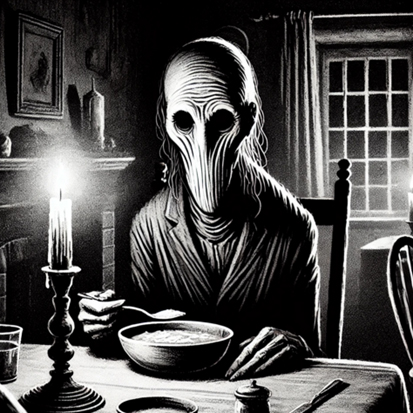
 The quiet suburban neighborhood of Cedar Grove was cloaked in a blanket of calm, the warm, orange glow of house lights flickering behind closed curtains as families gathered for evening meals. The air was thick with the smell of roasting meats, simmering sauces, and the faint clink of dishes being set. It was an unremarkable night, and in the Whitmore household, a dozen guests sat around a long dining table, sharing laughter and stories over an elaborate spread of food.
Margaret Whitmore, the hostess, was in her element. She loved hosting these gatherings—the wine, the ambiance, the chance to share her culinary creations. She hovered at the head of the table, beaming with pride as she poured another round of wine into the guests’ glasses, her eyes gleaming with satisfaction.
“To good friends, good food, and many more nights like this!” Margaret toasted, lifting her glass. The guests followed suit, smiling and clinking glasses as they joined in her cheer.
Plates were filled, and conversation flowed easily, laughter and warmth filling the air as everyone dug in, savoring the delicate flavors. Frank Russell, a real estate agent with a quick wit and an appetite to match, took a hearty bite of the roast. He smacked his lips in appreciation, nudging his wife, Diane.
“Now this is what I call a meal,” Frank said, wiping his mouth. “Margaret, you’ve really outdone yourself.”
Margaret blushed, waving off the compliment as she took her seat. “Oh, please! It’s nothing. I’m just glad you’re all enjoying it.”
But just as she settled in, a peculiar silence fell over the table. Across from her, Diane had stopped chewing, her fork hovering mid-air as her face twisted in a strange expression. Her eyes darted around the table, confused, her fingers clutching the edge of her napkin.
“Is… is anyone else feeling a little… off?” Diane murmured, a tremor in her voice.
Several guests paused, glancing at each other. Margaret felt her heart skip a beat. “Diane, what do you mean? Are you okay?”
Diane didn’t answer. Instead, she reached up, touching her cheek, her fingers coming away with a strange, viscous substance. She stared at her hand, her eyes widening as she registered the sticky, red substance glistening on her fingertips. A low gasp escaped her lips as she touched her face again, feeling something wet and soft—too soft.
“Frank…?” she whispered, her voice trembling. “Something’s wrong.”
Frank’s eyes went wide as he looked at his wife’s face, and in that moment, the room erupted into a symphony of gasps, choked cries, and horrified whispers. One by one, the guests reached up to their own faces, their expressions morphing from confusion to terror as they felt it—flesh loosening, slipping beneath their fingertips, like wax melting under intense heat.
“Oh God!” one of the guests, David, choked, clutching his face as he stumbled back, his chair scraping against the floor. His hand came away from his cheek, covered in a layer of red and pink tissue, the raw bone of his cheekbone glistening under the dining room lights. He turned to his wife, Helen, his voice thick with panic. “Helen… what’s happening?”
Margaret’s mind raced, her stomach turning as she watched her guests writhe, their fingers clawing at their faces in horror, desperate to stop the strange, sickening effect spreading across their skin. Diane’s mouth hung open in a silent scream as her cheeks slid downward, the muscle and skin separating from her face, exposing the white gleam of her jawbone.
Frank stumbled to his feet, his hand reaching out to his wife, his own face slick with red as his flesh melted away, clinging to his shirt in thick, sticky strings. “Diane! Someone—please! Help us!”
Margaret’s own skin felt hot, almost tingling, as if an invisible flame was licking at her face. Her heart pounded, and her breath came in short, frantic gasps. She could feel something wet at the corner of her mouth, and when she reached up to touch it, her fingers came away bloody, pieces of her own lip clinging to her hand.
“No… no, no, no,” she whispered, backing away from the table as her vision swam. Her beautiful dining room, once filled with laughter and light, was now a tableau of horror, her friends and neighbors transformed into grotesque, skeletal figures, their faces melting like candles left too close to a flame.
“Margaret,” Diane whimpered, her voice hoarse and wet, her throat exposed as the skin slipped down her neck in red, meaty clumps. “What’s happening to us?”
Margaret stumbled, her mind racing, her gaze fixed on the doorway as if expecting someone to burst in, to explain, to help. But no one came. The only sounds were the gurgling, muffled screams of her guests, each one clawing at their own face in a desperate, futile attempt to halt the decay.
Then, just as suddenly as it had begun, the silence returned, thick and absolute.
Margaret forced herself to look around the table, her vision blurred with tears and pain. The guests had stopped moving, their bodies slumped in their chairs, their hands limp at their sides. What remained of their faces were bare skulls, the flesh and muscle melted away, exposing empty eye sockets and grinning, skeletal jaws.
A wet sob escaped her lips as she staggered back, the horror of it all pressing down on her, suffocating. Her dining room, her guests… all of them reduced to macabre figures, a horrific sight out of some nightmare.
Margaret’s knees buckled, and she fell to the ground, her mind reeling as she tried to comprehend the impossible. She could feel her own face, raw and burning, the skin slipping away with each brush of her fingers, her own cheekbones now cold and exposed.
The silence was broken by a single, muffled noise—a low, mechanical hum coming from the kitchen. Margaret’s breath hitched as she recognized it, the sound both familiar and sinister in the stillness.
The microwave.
She forced herself to stand, her legs shaking as she stumbled toward the kitchen. The hum grew louder, more insistent, like a living thing, pulsing with a strange energy. She reached the doorway, her eyes wide with horror as she took in the sight.
The microwave door was open, the interior glowing with a sickly green light. Inside, a strange, thick liquid bubbled and hissed, the fumes rising in a hazy mist. Margaret’s stomach churned as she realized the smell—it was the same stench that filled the dining room, the smell of burning flesh, of something rotting and foul.
She covered her mouth, suppressing a scream as the light intensified, pulsing with a sickly, hypnotic rhythm that seemed to echo in her mind. And then, as suddenly as it had started, the hum stopped, the light flickering out, leaving the kitchen shrouded in darkness.
Margaret staggered back, her mind a whirl of terror and confusion. She looked down at her hands, at the blood and flesh that clung to her fingers, and a single, horrifying thought settled in her mind.
Whatever had happened to her guests, to her, it had come from inside the house.
And whatever it was… it was only just beginning.
Margaret’s dining room looked like a scene from a nightmare, a grotesque display of death frozen in stillness. The twelve guests—her friends, her neighbors, people she’d known for years—were unrecognizable. Their flesh, once warm and full of life, had melted away to reveal bare, grinning skulls and hollow eye sockets that seemed to watch her in silent accusation.
Her mind was numb, her thoughts fractured and chaotic as she tried to make sense of the horror before her. Her own face still felt raw, throbbing with an unbearable heat. She staggered to the hallway mirror, her heart pounding as she lifted a trembling hand to her cheek.
What she saw made her stomach turn.
The skin around her mouth and nose was red, raw, and blistered, pieces hanging loose where they’d started to peel away. She could feel the air against her exposed cheekbones, the sensation as foreign and wrong as if someone had peeled back the layers of her soul. Her reflection, the half-bare skull staring back at her, was something from a fevered nightmare.
Her breath came in ragged gasps, each one filled with the stench of rot and decay. She stumbled away from the mirror, unable to bear the sight any longer. Her vision blurred as she turned back to the dining room, desperate for some explanation, some reason for the unthinkable horror that had unfolded here.
And then she saw it—the faint, green glow coming from beneath the door of her basement. It pulsed rhythmically, like a heartbeat, filling the hallway with an eerie, unnatural light. The microwave had been just the beginning. Whatever was causing this… it was somewhere down there, hidden in the shadows of her own home.
Margaret took a shaky breath, her mind torn between a primal need to flee and a desperate urge to understand. She had to know what had caused this, what had turned her friends into skeletal remains, what was turning her into one as well.
With trembling hands, she reached for the basement door, her fingers slick with sweat as she twisted the knob. The door creaked open, revealing the dark stairwell that descended into the depths of her house. The green light flickered and pulsed, beckoning her, daring her to step forward.
She hesitated, fear gripping her heart, but a sick curiosity propelled her onward. Slowly, she descended the stairs, each step creaking under her weight. The air grew colder, denser, filled with the metallic tang of something unnatural, something that didn’t belong in this world.
As she reached the bottom of the stairs, she saw it—a strange, humming machine sitting in the center of the room, connected by a series of thick cables to her electrical panel. The machine was covered in dials and gauges, its surface slick with condensation, the green light pouring from its base in ghostly waves. It looked like something out of a mad scientist’s laboratory, a device built with no purpose other than to invoke fear.
Her stomach turned as she took a step closer, her eyes fixed on the pulsing green light. She had no idea how the machine had gotten there, no memory of ordering or installing anything like this. It seemed to have appeared overnight, like a parasite embedding itself in her home.
But as she drew closer, a memory flickered in her mind—an ad, one she’d seen just a few weeks ago on the TV. “Revolutionary new cooking device! Enhance flavor, texture, and more! Safe for home use. The future of culinary technology!” She had ordered it without much thought, eager to impress her guests with the latest cooking trends.
She hadn’t even remembered the name. But now, staring at it, she felt a wave of nausea wash over her. The Face Melter. The words blazed in her mind, mocking her, as if they’d been waiting to reveal themselves all along.
Margaret covered her mouth, bile rising in her throat as she pieced it together. The machine—this machine—had caused the unimaginable horror upstairs. It hadn’t just cooked the food. It had done something far worse, something beyond human understanding.
Her thoughts raced, and she felt the bile rise again as she glanced at the machine’s dials. One of them was labeled Resonance Frequency. Another read Cellular Breakdown, its needle still quivering in the red zone, as if whatever effect it had caused wasn’t yet finished.
She felt a dark thrill of horror as the truth began to settle over her. This device, whatever it was, hadn’t just cooked their food. It had emitted something, some kind of frequency or energy that had broken down their faces, disintegrating their skin and flesh from the inside out.
A low hum began to fill the room, growing louder, more insistent. Margaret took a step back, her hand reaching out to steady herself as the machine’s dials started to flicker, the green light intensifying, casting grotesque shadows on the walls. It was as if the machine were coming to life, responding to her presence, its pulsing light filling her mind with a sickening dread.
She stumbled back, her heart racing as she turned to flee, desperate to escape the horror that had taken root in her home. But just as she reached the stairs, the hum grew louder, almost deafening, filling her mind with a single, overpowering command:
FEED ME.
Margaret froze, her mind reeling as the words echoed in her head, relentless and consuming. She turned slowly, her body moving as if guided by some unseen force, her gaze fixed on the machine’s green glow. It was hungry, demanding, and it wouldn’t stop until it was satisfied.
Her breath hitched as she realized the truth. The machine wasn’t just a device. It was alive, sentient, feeding off the people it lured in. The dinner party had been its feast, a grotesque banquet that had left her friends reduced to skeletal husks.
“No,” she whispered, her voice trembling. “No, this can’t be real.”
But the machine hummed louder, its dials spinning wildly, as if mocking her, taunting her. And then, as if to confirm her worst fears, the words appeared on a small, digital screen embedded in the device:
INITIATE SECOND COURSE?
Margaret’s heart stopped. She knew instinctively that she was the next course, that the machine wouldn’t stop until it had finished what it had started. Her skin burned, her face raw and throbbing, and she felt a strange pull, as if her body were being drawn toward the machine, compelled by some dark, magnetic force.
She gritted her teeth, forcing herself to move, to fight the compulsion that urged her closer. Her eyes scanned the room, searching for anything that could help her destroy this thing, to end the nightmare once and for all. Her gaze fell on a heavy crowbar leaning against the wall, and without thinking, she lunged for it, her fingers closing around the cold metal.
With a cry of desperation, she swung the crowbar at the machine, the metal clanging against its surface with a sickening crunch. The green light flickered, the hum stuttering, as if the machine itself were wounded. Margaret felt a surge of adrenaline, her grip tightening as she struck again, over and over, her rage and fear pouring into each swing.
The machine sparked and sputtered, the green light fading as its dials cracked and shattered. The hum grew weaker, dying with each blow, until finally, with one last swing, the machine went silent, the green light winking out, leaving the basement in complete darkness.
Margaret collapsed to her knees, her body trembling, her breaths coming in ragged gasps. She could still feel the burn on her face, the rawness of her skin, but she knew it was over. Whatever horror she had unleashed was finally gone.
She staggered to her feet, making her way up the stairs, her mind numb with exhaustion and grief. The sight that awaited her in the dining room brought fresh tears to her eyes—her friends, still seated around the table, their skeletal faces frozen in silent screams, a testament to the nightmare she had unleashed.
Margaret stumbled out of the house, her feet carrying her away from the scene of horror, her heart heavy with guilt and horror. She didn’t look back as she disappeared into the night, her mind filled with the memory of that green glow, the hum that had echoed through her mind, demanding to be fed.
But somewhere, deep in the recesses of her mind, a new fear took root—a fear that the machine wasn’t truly gone, that it had simply gone dormant, waiting for its next feast, its next course.
And as Margaret vanished into the darkness, she knew one thing for certain.
This was only the beginning.
The aftermath of the dinner party horror rippled through Cedar Grove like a shockwave, transforming the quiet suburban neighborhood into a hive of police activity. Emergency vehicles lined the street in front of Margaret Whitmore’s house, their flashing lights casting eerie shadows over the pristine lawns. Neighbors gathered at their windows, whispering in hushed voices, speculating about what had happened behind those closed doors.
Detective Adrian Cole arrived at the scene just past midnight, his tired eyes scanning the crowd of onlookers and the unsettling stillness that seemed to hang over the house. He had seen his share of horrific crime scenes, but something about the atmosphere here sent a chill through him. There was a strange energy, an oppressive heaviness in the air that made his skin prickle.
Cole tightened his coat around him as he walked up the driveway, nodding at the officer stationed by the door. “What’s the situation, Andrews?”
Officer Andrews looked pale, his eyes wide and darting as if he were struggling to process what he’d seen. He shook his head, swallowing hard. “I… I’ve never seen anything like it, sir. Twelve people. All of them dead. And… it’s their faces.”
Cole raised an eyebrow. “Their faces?”
Andrews nodded; his expression haunted. “Or… what’s left of them. It’s as if the flesh just… melted away, right off the bone.”
Cole’s stomach tightened. He’d heard of various causes of skin and flesh deterioration, but nothing like what Andrews was describing. “Has anyone spoken to the homeowner?”
“Ms. Whitmore?” Andrews cleared his throat, his gaze shifting nervously. “She… she ran. Witnesses say they saw her leave, but we haven’t found her yet. Honestly, I can’t say I blame her. You’ll see what I mean.”
With a curt nod, Cole stepped inside, bracing himself as he entered the dining room. But no amount of preparation could have prepared him for what he saw.
The dining table was set as if for a holiday feast, each place meticulously arranged with fine china, polished silverware, and delicate wine glasses, all untouched. But the twelve figures seated around the table were frozen in grotesque poses, their skulls exposed, hollow eye sockets staring into the void. Bits of flesh clung to the bones, congealed blood pooling around their collars, their hands slack and limp in their laps. The remains of the meal lay scattered before them, untouched, as if time had stopped in the middle of their last bite.
Cole’s breath caught in his throat as he scanned the scene, his mind racing to comprehend the horror before him. It was as though some unseen force had stripped the faces from these people, leaving them transformed into ghastly skeletons, frozen forever in that macabre dinner party.
Detective Lisa Tran, his partner, appeared beside him, her face pale as she took in the scene. “Jesus,” she whispered, her hand covering her mouth. “What the hell could have done this?”
Cole shook his head, his mind racing through possibilities. “I don’t know. Chemical exposure, maybe, or some sort of extreme allergen. But this…” He trailed off, gesturing to the dining room, “I’ve never seen anything like it.”
Lisa leaned in closer, her gaze drawn to the fragments of flesh still clinging to the bones. “It’s almost as if… the flesh liquefied somehow. Look at this.” She pointed to a trail of what appeared to be viscous, partially coagulated blood pooling around the base of each chair.
Cole frowned. “Something triggered this. Something in this house.”
As they circled the room, trying to piece together the mystery, a forensic technician, Karen Rodriguez, entered, her equipment slung over her shoulder. She glanced at the bodies, her face growing taut with discomfort. “We’ll start with tissue samples, but I can already tell you… this doesn’t look like anything biological.”
“What do you mean?” Cole asked, watching her as she approached the first skeleton.
She pulled out a swab, carefully collecting a sample from the exposed jawbone. “This doesn’t appear to be any kind of conventional decomposition. It’s more like accelerated erosion, or… breakdown on a cellular level.” She glanced at Cole, her brow furrowing. “Like they were dissolved from the outside in, but in real-time. Rapidly.”
Cole’s mind buzzed with questions. “What about the kitchen? Anything unusual?”
Rodriguez nodded. “We found an odd device down in the basement. It looks like some kind of industrial microwave or prototype cooking unit. It was smashed to pieces, though—it’s hard to say what it even did. But it was giving off weird energy readings before it was destroyed. We’re taking it back to the lab.”
Lisa shot Cole a concerned look. “Could the device be responsible?”
“It’s the only lead we have.” He shook his head, a chill creeping down his spine. “Let’s hope it tells us something.”
As Rodriguez left, Cole’s gaze wandered to a single empty chair at the table. “One of these chairs was empty. Someone was here, and they got away.”
“Margaret Whitmore,” Lisa replied, glancing at her notes. “The hostess. Neighbors said she left the house right after dinner. Ran down the street covered in blood, and no one’s seen her since.”
Cole clenched his jaw. “We need to find her. She’s our only witness—and maybe our only suspect.”
The search for Margaret Whitmore stretched late into the night, officers canvassing the neighborhood and beyond, interviewing anyone who might have seen her. The few people who had noticed her described her as frantic, distraught, her face partially melted, skin hanging loosely as if scorched by an invisible fire.
It wasn’t until dawn that they finally found her.
She was crouched in a narrow alley several blocks from her house, her body hunched, shivering violently. Her face was a ghastly sight, the skin blistered and raw, patches missing to reveal bone and muscle beneath. She was muttering to herself, her eyes wide and unseeing, as though trapped in some waking nightmare.
Cole and Lisa approached her slowly, careful not to startle her.
“Margaret?” Cole said softly, crouching down to her level. “It’s Detective Cole. We’re here to help you.”
Her gaze snapped up, wild and terrified. She didn’t seem to register his words, her hands twitching as she clawed at her own face, her fingers trembling as they brushed against the exposed bone.
“He… he wanted us to eat,” she whispered, her voice choked, her eyes wide with horror. “He was hungry. The machine… it said it wanted… more.”
Cole felt a chill settle over him, her words cryptic and unsettling. “Margaret, who is ‘he’? Are you talking about the machine?”
She nodded, a shudder running through her. “It… it whispered to me, told me to serve… told me it wanted a feast. I thought… I thought it was just for cooking. But it wasn’t. It ate them. It melted them, devoured them.” Her voice trailed off, her gaze turning distant.
“Margaret, we found the machine. It was in your basement. Can you tell us how you got it?”
Her eyes flickered with a faint recognition, but then a strange, hollow laugh escaped her lips. “An ad… I saw an ad… said it would change everything. But it changed us, didn’t it? It took them. Took me.” She glanced down, her fingers brushing over her face, the skin sloughing off under her touch.
Lisa looked at Cole, her eyes wide with shock. “This sounds like some kind of… experimental technology gone wrong. But why would it… do that?”
Margaret’s laugh turned into a sob. “It’s not a machine. It’s a thing. It has a will of its own. It’s alive. And it’s still hungry…”
Her words dissolved into gibberish, her mind unraveling as the horror of the night overtook her. Cole motioned for the medics to move in, watching as they carefully lifted her onto a stretcher, her body limp, her eyes glassy with terror.
As they loaded her into the ambulance, Cole turned to Lisa, his mind racing. “Whatever that machine was, it didn’t just malfunction. It was designed to do this, to feed on these people. And Margaret’s not crazy—it left her alive for a reason.”
Lisa shivered. “So what do we do? How do we even begin to understand this?”
Cole’s gaze darkened. “We start with the machine. And we find out who created it, who sold it. If this thing is still out there… we need to destroy it before anyone else gets hurt.”
As the sun rose over Cedar Grove, Cole and Lisa stood in the quiet, deserted street, the weight of what they had seen settling heavily on their shoulders. Whatever horror had unleashed itself in Margaret Whitmore’s home was still out there, lurking in the shadows, waiting for its next victim.
And as they made their way back to the station, Cole knew one thing for certain: they were facing something far beyond their understanding, something that defied logic and reason.
Something that hungered.
Detective Cole sat in his cramped office, the dim light from his desk lamp casting long shadows over the stacks of case files and photos scattered in front of him. His eyes lingered on the picture of Margaret Whitmore—her face frozen in terror, her expression hollow and wild. He could still hear her voice in his head, the tremor, the hysteria: “It wanted us to eat… It’s still hungry…”
Across from him, Lisa sat tapping away on her laptop, her brow furrowed in concentration as she scanned through pages of data on the mysterious device recovered from Margaret’s basement. It was no ordinary cooking gadget; the lab report had made that clear. The device operated on frequencies and technology far outside the norm, designed to manipulate matter in ways no consumer product should.
“This isn’t some kitchen gimmick,” Lisa murmured, scrolling through the lab analysis. “It emits high-intensity microwave bursts paired with something called thermal resonance fields. I don’t even know what that means. The lab tech said it’s the kind of equipment you’d expect to see in a government lab… or an experimental weapons facility.”
Cole shook his head, an icy chill creeping down his spine. “If it’s that advanced, how did it end up in Margaret Whitmore’s house?”
Lisa pushed a printout across the desk, her expression darkening. “It was custom-built by a company called Neuronex Dynamics. They’re known for creating high-tech prototypes—experimental weapons, AI, and some pretty hush-hush biotechnology.” She paused, glancing at him with a troubled look. “But get this—the product wasn’t for sale. The ad she saw? It wasn’t even part of a legitimate campaign.”
Cole’s jaw tightened. “Someone must have set it up for her to find.”
Lisa nodded. “Exactly. Whoever designed that ad wanted her to buy it. It was targeted—almost like she was chosen.”
Cole ran a hand over his face, the pieces beginning to fall into place. “So we’re dealing with something more sinister than a cooking device gone wrong. This was orchestrated. But why target Margaret?”
Lisa’s fingers danced across the keyboard as she pulled up Margaret’s purchase records. “I’ve got a contact at Neuronex Dynamics,” she said, a hint of hesitation in her voice. “Dr. Evan Markham. He’s one of their engineers. If anyone knows the origins of this device, it would be him.”
Cole didn’t need any more convincing. “Let’s pay him a visit. If this machine came out of his company, he may be our best shot at understanding what the hell is going on.”
They arrived at Neuronex Dynamics’ headquarters later that afternoon, a sleek glass structure looming above the city with reflective walls that seemed to swallow the light. Inside, the building was cold and sterile, filled with labs and offices manned by people in crisp lab coats, moving through the halls with quiet efficiency. It felt detached, alien—a place more suited to secret experiments than a cooking device.
A receptionist led them through a maze of corridors to a lab tucked away at the back of the building. There, Dr. Evan Markham was waiting for them, his face thin, gaunt, and shadowed with exhaustion. He looked up as they entered, his gaze wary, as if he already suspected what they’d come to ask him.
“Detective Cole, Detective Tran,” he said, nodding in greeting. “I heard you wanted to discuss one of our prototypes. The lab informed me about the incident involving Margaret Whitmore. Unfortunate, to say the least.”
Cole cut straight to the point. “Unfortunate? Doctor, twelve people are dead because of that device. Margaret’s face melted off, her skin stripped like wax. You call that unfortunate?”
Dr. Markham’s face remained impassive, though his fingers tapped nervously against his clipboard. “Believe me, Detective, we’re as disturbed as you are by what happened. But I should clarify—Neuronex Dynamics didn’t authorize any commercial sale of this product. It was part of a classified project we were developing for… specialized applications. Someone took it and modified it for consumer use, in a way that it was never intended for.”
Lisa’s eyes narrowed. “Modified? You’re saying it was altered to function as a regular kitchen appliance?”
Dr. Markham nodded. “Yes. We developed the initial technology to affect cellular structures—only in non-human applications. The machine’s capabilities are theoretically boundless. But in the wrong hands, it could… well, clearly, it’s capable of what you witnessed.”
Cole folded his arms, his patience wearing thin. “Who would do that, Doctor? Who would take your machine, twist it into some household death trap, and release it to the public?”
Markham sighed, his shoulders slumping as he leaned against the lab bench. “A rogue engineer, a former colleague of mine named Gabriel Lawson. He was… brilliant, obsessed with the boundaries between technology and biology. But his work grew increasingly experimental, unethical. He believed he could manipulate matter, break it down, rebuild it in new forms. We had no idea he’d take it this far.”
Lisa looked at him, disbelief etched on her face. “So you’re saying this Lawson designed the machine to… consume people?”
Markham nodded, a haunted look in his eyes. “It’s what he wanted. He talked about the machine as if it were alive, a creature with its own hunger. He believed that if he could feed it the right energy, the right… life force, it would evolve into something beyond technology. He called it The Face Melter. And now, it appears he’s testing it on unsuspecting people.”
Cole felt a chill settle over him. This wasn’t just murder; it was something darker, an experiment in pain and horror. He needed to find this Lawson before anyone else fell victim to his twisted creation.
“Where is he now?” Cole asked, his voice steely.
Markham shook his head, regret darkening his gaze. “We don’t know. Lawson left the company six months ago, right around the time the prototype went missing. We thought he’d vanished, disappeared. But it seems he’s been here, watching his creation wreak havoc.”
Cole took a step closer, his voice low. “Give us everything you have on Lawson. Any addresses, known contacts—whatever we can use to track him down.”
Markham nodded, scribbling down an address on a piece of paper. “I heard he kept a storage unit across town. It’s the last known location he was seen. I’ll have our security team provide you with everything we have.”
Cole took the paper, his mind racing. “One more thing. Is there any way to destroy the machine? A way to reverse what it’s done?”
Markham hesitated, his face pale. “The device is self-sustaining. It operates on an algorithm Lawson designed, something he called The Circuit. It’s… adaptive, a feedback loop that grows stronger with each activation, feeding off the energy it consumes. Destroying it might be impossible… but if you could disable the Circuit, it might shut it down permanently.”
Cole nodded, grim determination settling over him. “Then we’ll start there.”
The storage unit was in a decaying industrial district on the outskirts of town, a shadowy maze of rusted metal and forgotten buildings. The air was thick with the smell of oil and rot, the scent clinging to their skin as they approached Lawson’s last known hideout.
The unit was old, its door covered in grime and rust. Cole forced it open, the door screeching as they stepped inside, the dim light from a single hanging bulb casting flickering shadows across the space.
The storage unit was filled with workbenches covered in tools, blueprints, and small prototypes—versions of the device Margaret had unknowingly used in her home. But the thing that caught Cole’s eye was a large metal box in the corner, covered in wires and circuit boards, humming faintly.
Lisa approached it cautiously, her flashlight illuminating a small plaque bolted to the side. The words were etched with clinical precision, cold and unsettling: Mark 1 Prototype: Biomass Consumption Device.
Cole’s stomach twisted. “Biomass consumption? This… this thing was always meant to feed on people.”
Lisa nodded, her face pale. “This wasn’t an accident. Lawson designed it with intent.”
As they sifted through the blueprints, Cole’s gaze landed on a sheet covered in scrawled, manic handwriting. Words like life energy, cellular breakdown, and energy circuit jumped out at him. But in the margin, in small, precise letters, was a final, ominous note:
FEED UNTIL TRANSFORMATION COMPLETE.
Lisa’s hand trembled as she read the note over his shoulder. “What transformation? What does that mean?”
Cole shook his head, dread thickening in his chest. “I don’t know. But whatever it is, Lawson believed this machine would evolve into something worse.”
They gathered the files, stuffing them into bags as they scanned the blueprints, piecing together Lawson’s twisted vision. But as they turned to leave, the faint hum of the device grew louder, filling the room with an eerie, almost human whisper.
Cole’s blood ran cold as the machine powered up, the hum morphing into a low, throaty hiss.
Feed me.
The words seemed to pulse in the air, thick with hunger, filling the small space with an unbearable pressure.
Without another word, they bolted from the unit, slamming the door shut behind them, the machine’s hunger echoing in their minds as they stumbled back into the night.
They knew now that this was more than a rogue experiment. Lawson’s machine was alive, a creature born of circuits and malice, evolving with each victim it consumed.
And somewhere out there, Lawson was waiting, watching, feeding his creation with the lives of the unsuspecting, pushing it toward its final, terrible form.
The engine of Detective Cole’s unmarked car hummed softly as he and Lisa sped down the empty streets, the files they had taken from Lawson’s storage unit sprawled across the back seat. The words scrawled on those pages were burned into Cole’s mind: “Feed until transformation complete.” He couldn’t shake the feeling that they were racing against the clock, that with each passing minute, Lawson’s device was edging closer to some horrific transformation.
“We need to know more about Lawson,” Cole muttered, gripping the wheel tightly. “If he’s been monitoring the machine, there has to be a pattern. Some way he’s picking his targets.”
Lisa glanced at her laptop, her fingers flying over the keys as she accessed police and medical records. “I’m pulling up any incident reports over the past few months that might match these… effects.” Her brow furrowed. “There’s been a string of unexplained deaths in neighboring towns. People were found with severe tissue damage, skin lesions, and even skeletal exposure, but the causes were labeled as undetermined.”
She turned the screen toward him. “Look at this—it goes back further than Margaret’s dinner party. There are reports from nearly six months ago. But nothing caught the connection because the victims were all from different areas.”
Cole clenched his jaw. “Lawson’s been running tests. Each time refining the machine, making it deadlier.”
Lisa nodded, her face grim. “These records show a clear escalation. The earlier cases were isolated, almost controlled—smaller breakdowns, like trials. But now it’s spreading. The machine’s output is growing more… aggressive.”
They pulled into the parking lot of a small motel on the outskirts of town. This was the last known address they had for Lawson, a tip they’d dug up from his financial records. The place looked run-down, the neon sign flickering erratically above a line of battered doors.
As they stepped out of the car, the air felt thick, charged, as if the entire area were holding its breath. Cole and Lisa approached the door to Room 15, the paint peeling, the door slightly ajar. Cole exchanged a glance with Lisa before pulling his gun, his voice low.
“Stay behind me,” he murmured, pushing the door open with his shoulder.
Inside, the room was a chaotic mess of discarded blueprints, wires, and electronic parts. It looked like a makeshift lab, with half-built circuits and strange, metallic contraptions covering every surface. The walls were lined with scribbled notes, formulas, and calculations, all scrawled in a frenzied hand. But it was the photographs tacked to the wall that made Cole’s stomach lurch.
They were of Margaret Whitmore, taken at various places around Cedar Grove: her home, the grocery store, the park. Beside them were photos of her guests, each one marked with dates and times. The final photograph was of Margaret in her dining room, taken moments before the dinner party. Below the photo, a single line was written in red ink:
“Feast begins at dusk.”
Lisa’s face paled as she scanned the wall. “He’s been watching them. Stalking them. Margaret’s dinner party was just a test… a controlled experiment. He knew exactly what the machine would do.”
Cole felt a surge of anger as he looked at the twisted documentation of Lawson’s experiment. “This was never about technology or progress. He’s using this machine to feed his own sick fascination.”
He scanned the room, his eyes landing on a small, cracked journal sitting on the desk. He picked it up, flipping through the pages. Most of it was incomprehensible—mathematical equations and sketches of human anatomy mixed with cryptic symbols. But one passage caught his eye, written in careful, deliberate script:
“The machine is more than a tool. It is alive, evolving with each life it consumes. Soon, it will reach the threshold, becoming something beyond comprehension. The human form is weak, limited. This device… it will give me the body I deserve.”
Lisa’s eyes widened as she read over his shoulder. “He doesn’t just want to experiment on others. He wants to become… something else.”
The words sent a chill through Cole. “That’s why he calls it The Face Melter. It’s not just about stripping flesh. It’s about breaking down human bodies and reshaping them. But into what?”
They stood in stunned silence, the gravity of Lawson’s intentions settling over them like a shroud. This wasn’t just a murder spree; it was a twisted pursuit of some form of evolution.
A sudden thud echoed from the back of the room, snapping them out of their horror. Cole and Lisa turned, guns drawn, as they moved toward a closet at the far end of the room. The door rattled, and a faint, muffled voice sounded from within.
“Help… please…”
Lisa moved forward, pulling the closet door open. Inside, huddled in a corner, was a man in his early thirties, his face bruised and pale, his wrists bound with a tangled mess of wires. His eyes were wide with fear as he looked up at them, his voice hoarse.
“Are… are you the police?”
Cole nodded, holstering his gun. “We are. Who are you? Did Lawson do this to you?”
The man shuddered, his face etched with terror. “Yes… my name’s Carl Hughes. I used to work with him, back at Neuronex. I had no idea what he was building until it was too late. He said he needed my help to finish the device, but once I saw what it was doing, I tried to leave. That’s when he… he trapped me here.”
Lisa crouched beside him, carefully removing the wires around his wrists. “Carl, can you tell us anything about the device? Is there any way to stop it?”
Carl’s face contorted with fear and regret. “I… I designed part of the Circuit. It’s an adaptive feedback loop—feeding on energy, growing stronger with each activation. Gabriel believed it would evolve, become something… organic. I thought he was crazy, but he said he’d proven it… by feeding it.”
Cole felt his stomach turn. “He’s using people as fuel.”
Carl nodded, his hands shaking. “Yes. And the more it consumes, the closer it gets to a critical point. Soon, it won’t need to be plugged in; it’ll sustain itself, independent. It’ll be unstoppable.”
Lisa exchanged a look with Cole, dread tightening in her chest. “Then how do we stop it?”
“There’s a failsafe built into the Circuit,” Carl whispered, his voice barely audible. “If you can access the core of the device and overload it, it’ll short-circuit, shut down permanently. But… but Gabriel removed the failsafe. He knew I’d try to disable it.”
Cole’s hands clenched into fists. “Where is he, Carl? Where would he go if the device was close to… whatever he thinks it’s going to become?”
Carl swallowed, his gaze drifting to the corner of the room where another set of blueprints lay. “There’s one more place he always talked about. An old warehouse where he kept the earliest prototypes. If he’s trying to force the device to evolve, he’ll be there, somewhere he can monitor it as it reaches… whatever he’s hoping for.”
Cole’s jaw tightened. “Then that’s where we’re going.”
He helped Carl to his feet, guiding him to a chair. “Stay here. Call for backup, tell them what you know, and stay out of sight until we get back.”
Carl’s face was ashen, but he nodded, a look of desperation in his eyes. “Be careful. If you see the machine… don’t get too close. The field it emits… it draws you in, like it’s pulling your very cells apart.”
Cole and Lisa left the motel room, a renewed sense of urgency propelling them forward. As they drove to the warehouse, the sun had dipped below the horizon, casting the sky in hues of bruised purple and deepening black. The city’s lights flickered on, illuminating streets that now felt empty, haunted by Lawson’s twisted experiments.
When they reached the warehouse, it was shrouded in darkness, looming over them like a sleeping beast. Cole felt his pulse quicken as they approached, his instincts screaming that whatever lay within those walls was something no one should ever have created.
Inside, the warehouse was cold and silent, the air thick with an electric tension that prickled at their skin. At the center of the room, bathed in a sickly green light, was the device. Larger than any previous version, it pulsed and hummed, as if alive, as if waiting.
And standing beside it, his face twisted with dark satisfaction, was Lawson.
He looked up as they entered, his smile widening. “Detectives,” he said, his voice a chilling whisper. “Just in time. The machine is almost ready. Soon, it will transcend… and so will I.”
Cole raised his gun, his voice steely. “It’s over, Lawson. Step away from the machine, and come with us.”
Lawson only laughed, his gaze flickering with a fanatical gleam. “Over? This is just the beginning! Don’t you see? This machine is my life’s work. It will remake me. Perfect me.”
Lisa moved to the side, her gun aimed steadily at Lawson. “Your work is murder, Lawson. You can’t escape this.”
Lawson’s smile twisted, his eyes flashing. “Maybe not… but I’ll live on. In this machine, in everything it touches.” He pressed a button on the device, the green light intensifying, filling the room with a sickening hum.
Cole and Lisa felt it immediately—the heat, the pull of the machine’s energy, as if their very cells were being tugged toward it. The sensation grew stronger, a creeping warmth that turned to searing pain.
But Cole forced himself to raise his gun, aiming for the Circuit—the core of Lawson’s twisted creation. In one swift move, he fired, the bullet hitting the device’s exposed center. Sparks flew, the green light flickering wildly as the machine sputtered, struggling against the damage.
Lawson screamed, lunging toward the device, his hands scrambling to repair it. But Lisa fired again, hitting the core, shattering it completely.
The machine let out a piercing scream, a sound that tore through the warehouse as the green light imploded, pulling inward, consuming itself. Lawson’s face contorted in terror as the energy he had tried to control enveloped him, dissolving his flesh, stripping him down to the bone.
Within seconds, the machine went silent, leaving nothing but smoke, the faint smell of burnt ozone, and Lawson’s skeletal remains.
Cole and Lisa stood in stunned silence, the weight of the nightmare settling over them. The machine was destroyed, its creator gone, but the memory of its hunger would haunt them forever.
They left the warehouse, the city now quiet, knowing that the horror Lawson had unleashed would leave scars that might never fade.
The End
